Why Your Resume Has No Impact Without Numbers (And How to Fix It)
 Ayush Panthri | Published: | Updated: | Reviewed By
  Kunal Saxena
Most people build their own resumes with good design, clear sections, and no spelling mistakes using tools. Their resumes are ATS-friendly and receive good ATS scores. However, even then, they do not receive responses or interview calls from recruiters.
This indicates that there may be an issue with their resumes, such as a lack of numbers or metrics in the content.
A resume without numbers is like a story without proof.
You may have great experience, but without measurable results, your resume does not look impactful to recruiters.
- Recruiters won’t see your value
- ATS won’t rank you well
- Opportunities will pass you by
In this article, we will discuss how numbers, data, and metrics can impact your resume and how you can fix this problem manually or with the help of tools. So, read the full article below.
By end of this you”ll know
What’s wrong?
One of the biggest problems with most resumes is that, without quantifiable results like numbers, data, and metrics, they fail to clearly show your actual impact and value to employers.
They describe what you did, but not what you achieved.
Instead of showing results, resumes are filled with tasks like:
- “Responsible for managing projects”
- “Worked on sales and marketing”
- “Handled customer queries”
These lines do not tell recruiters anything meaningful.
They do not answer the one question every recruiter has: ”What difference did this person actually make?”
Without numbers, your resume becomes:
- Common
- Forgettable
- Hard to compare with other candidates
Why it hurts?
When you apply for a job, many equally qualified and talented people also apply as well, so your resume is compared with other candidates’ resumes.
If you have a generic resume without any quantifiable impact, while another candidate’s resume is well-written and highlights what they did, its impact, and exactly how much it benefited the company, their resume will receive more attention.
Because it includes strong numbers, metrics, and impact-oriented bullet points, that candidate stands out and gets shortlisted by the company.
A recruiter will ignore your generic resume and choose the one with solid results and data, giving that candidate the interview/job instead of you.
So, it is important to add numbers or metrics to clearly show your results and the actual impact of your resume to recruiters.
Example (Bad vs Good)
This section shows the difference between a weak resume point and a strong one.
The goal is simple:
Turn what you did (task) into what you achieved (results).
| Bad Examples (Task-Based) | Good Examples (Result-Based) |
|---|---|
| These examples only describe responsibilities but not any credibility in your resume. | These examples show clear achievements with measurable impact on your resumes. |
| 1. Managed a team of sales executives | 1. Led a team of 5 sales executives, increasing revenue by 30% in 6 months. |
| 2. Worked on improving website performance | 2. Improved website speed by 40%, reducing bounce rate by 25%. |
| 3. Responsible for handling customer complaints | 3. Resolved 95% of customer complaints within 24 hours, improving satisfaction score by 20%. |
| Problem: These lines are too general and could apply to anyone. | That’s why resumes with numbers stand out and get easily shortlisted. |
How to fix ?
There are two effective ways to fix your resume and add measurable impact:
Manual Fix (Do It Yourself)
In this method, you can review your resume manually and identify where you can add metrics to improve your resume’s content quality and clearly show your impact to recruiters.
Rule of Thumb: Always include metrics when talking about results.
Here are the types of metrics you can use:
1. Percentage (%) Metrics
Percentage metrics show growth, improvement, or decline in your work. They help recruiters quickly understand how much impact you created.
Example:
Increased website traffic by 35% in 3months.
2. Revenue / Money Metrics (₹ / $)
Revenue or Money metrics show the financial impact of your work. They help recruiters understand how your actions contributed directly to business growth, sales, or cost savings.
Example:
Generated ₹5 lakh in sales within 6 months.
3. Time-Based Metrics
Time-based metrics show how quickly or efficiently you completed a task. They highlight your ability to save time, meet deadlines, and improve processes.
Example:
Reduced processing time from 5 days to 2 days.
4. Quantity / Volume Metrics
Quantity or volume metrics show the scale of your work like how much you handled, managed, or delivered. They help recruiters understand how big your responsibilities were.
Example:
Handled 100+ client queries per day.
5. Ranking / Position Metrics
Ranking or position metrics show your performance level compared to others. They highlight where you stand like top performer, high achiever, or among the best in your team or organization.
Example:
Ranked among the top 5 performers in the team
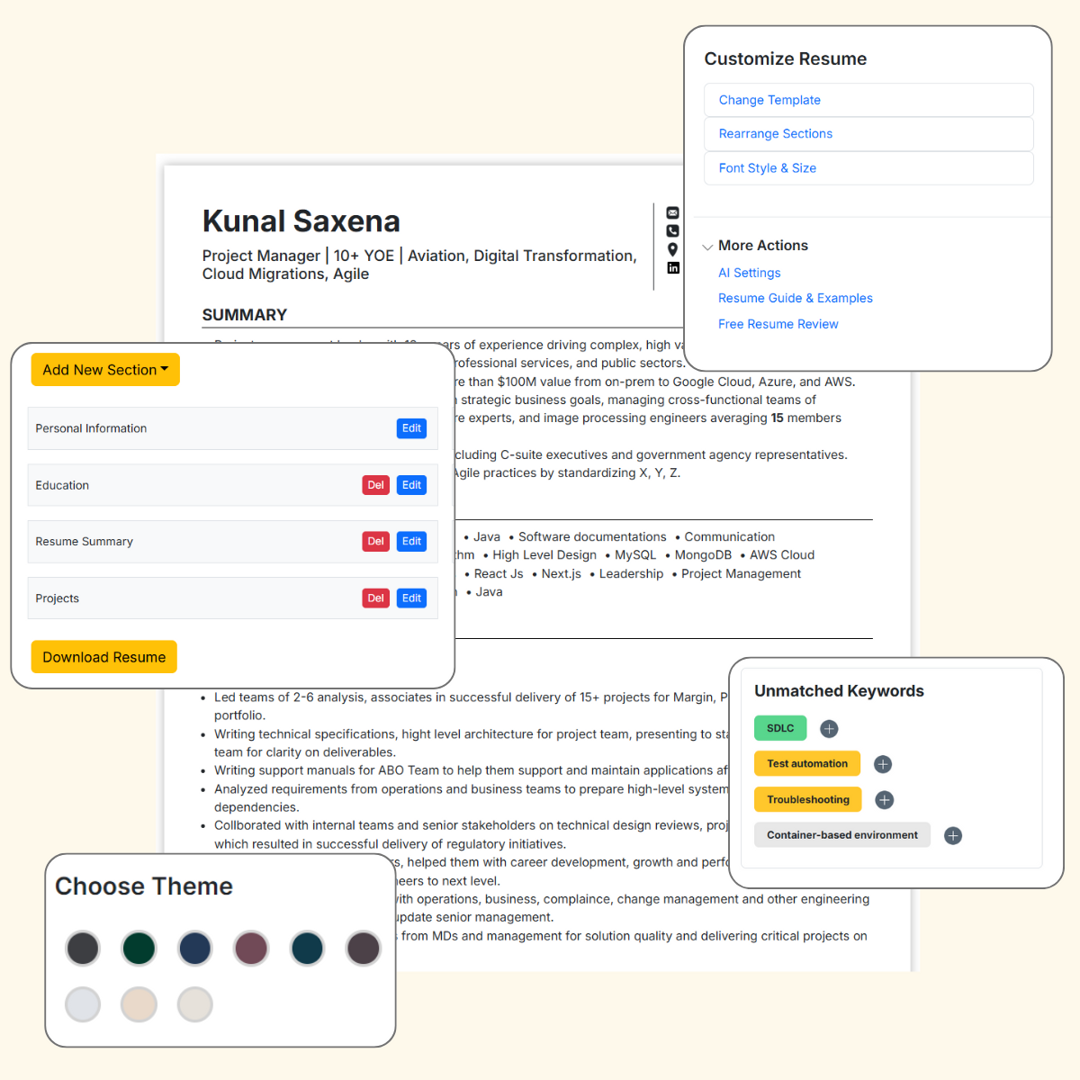
With AI Resume Builder (Faster Method)
If you want a quicker and guided approach:
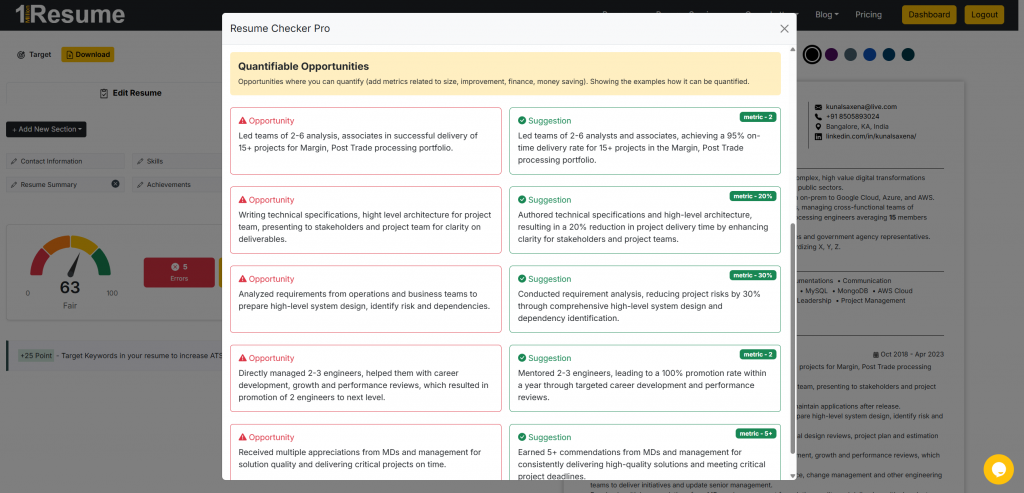
You can use our AI resume builder tool and upload your resume, the in-built resume checker tool will:
- Scan your resume instantly
- Identify 5-6 areas where metrics are missing
- Suggest specific improvements and examples
- Help you add numbers in the right places
It helps you improve your resume without confusion.
It is a faster and more efficient method compared to doing everything manually.
Friction Breaker
A friction breaker removes doubts, confusion, and hesitation of a jobseeker. It makes things feel simple, clear, and doable.
This is the situation where most job seekers get stuck. Let’s fix it for you.
“I don’t have numbers”
You have but – you’re just not thinking about them correctly.
Think in everyday terms:
- How many tasks did you complete daily?
- How often did you meet deadlines?
- How many clients did you handle?
- What is the size of the team?
Even small numbers matter.
“I don’t know my metrics”
Use estimates (realistic ones):
- “Handled 20+ client queries daily”
- “Supported a team of 10 members”
Approximate numbers are always better than no numbers.
“My role doesn’t support this”
Every role creates impact – you just need to identify it.
Examples:
- HR → “Reduced hiring time by 15%”
- Support → “Maintained 98% customer satisfaction”
- Admin → “Managed operations for 3 departments efficiently”
If your work created value, it can always be measured.
And once you show that value with numbers, your resume becomes stronger, clearer, and more convincing to recruiters.

Author – Ayush Panthri
Connect on LinkedIn

Reviewer – Kunal Saxena
Kunal is a seasoned Technical Resume Writer with over 13 years of experience working with startups, mid-sized firms, and top global companies like Goldman Sachs and EY. He brings deep domain expertise across tech, education, insurance, e-commerce, and investment banking.
He has helped hundreds of professionals from top firms—including Apple, Meta, Google, Adobe, and Amazon — land interviews and advance their careers globally. His approach blends real-world hiring insight with high-impact resume strategy.
Kunal is an active member of Career Thought Leaders and the Resume Writing Academy, staying current with global resume trends and recruiter expectations.
Connect on LinkedIn
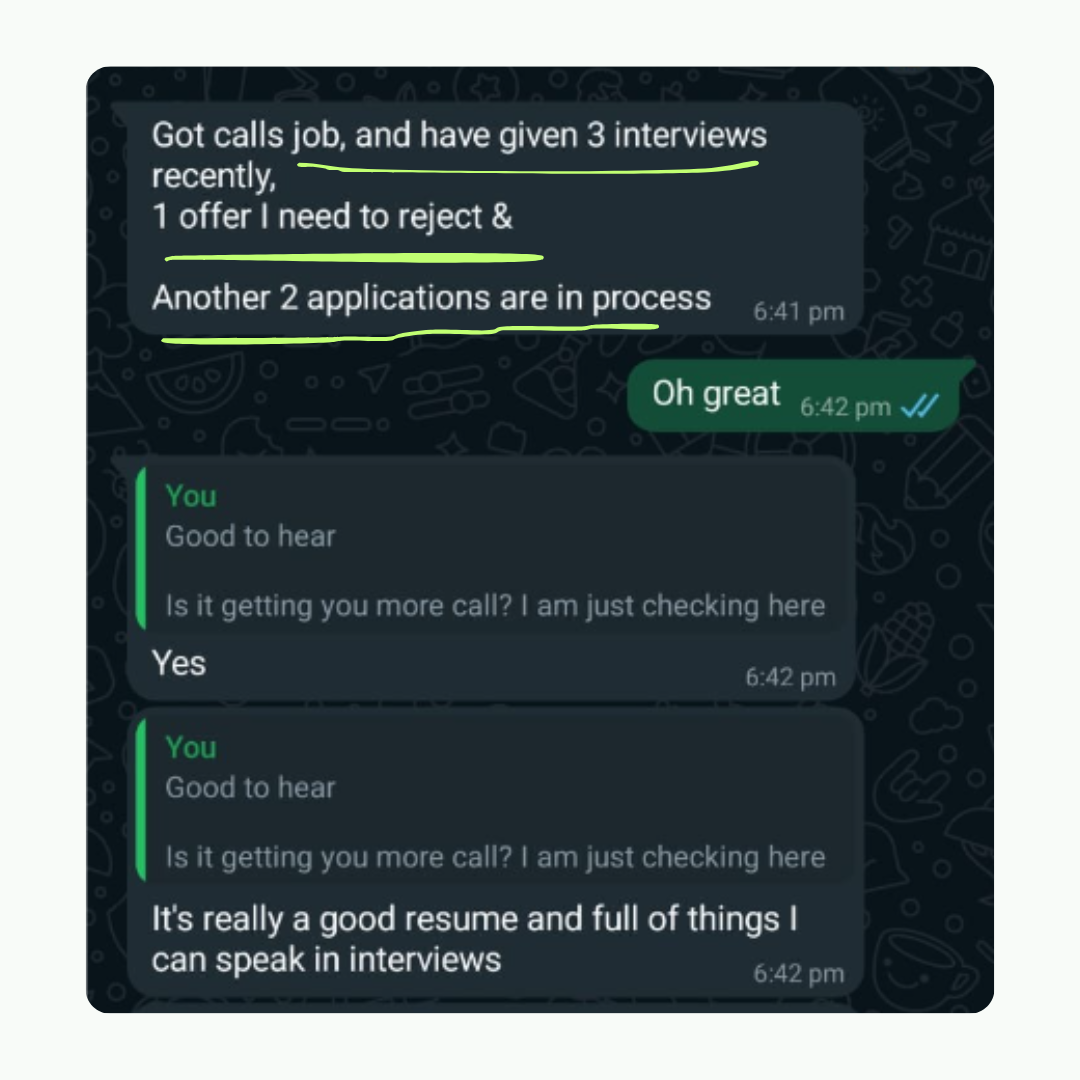
Amit got 2 Offers with our resume builder

My experience was truly outstanding, I got 3-5 interview calls and 2 job offers. The resume wasn't just focused on my current job - it captured my consulting, technical and leadership skills as well. Plus this was much more affordable
Data Engineer - Deloitte