Common ATS Resume Mistakes & Myths
 Ayush Panthri | Published: | Updated: | Reviewed By
  Kunal Saxena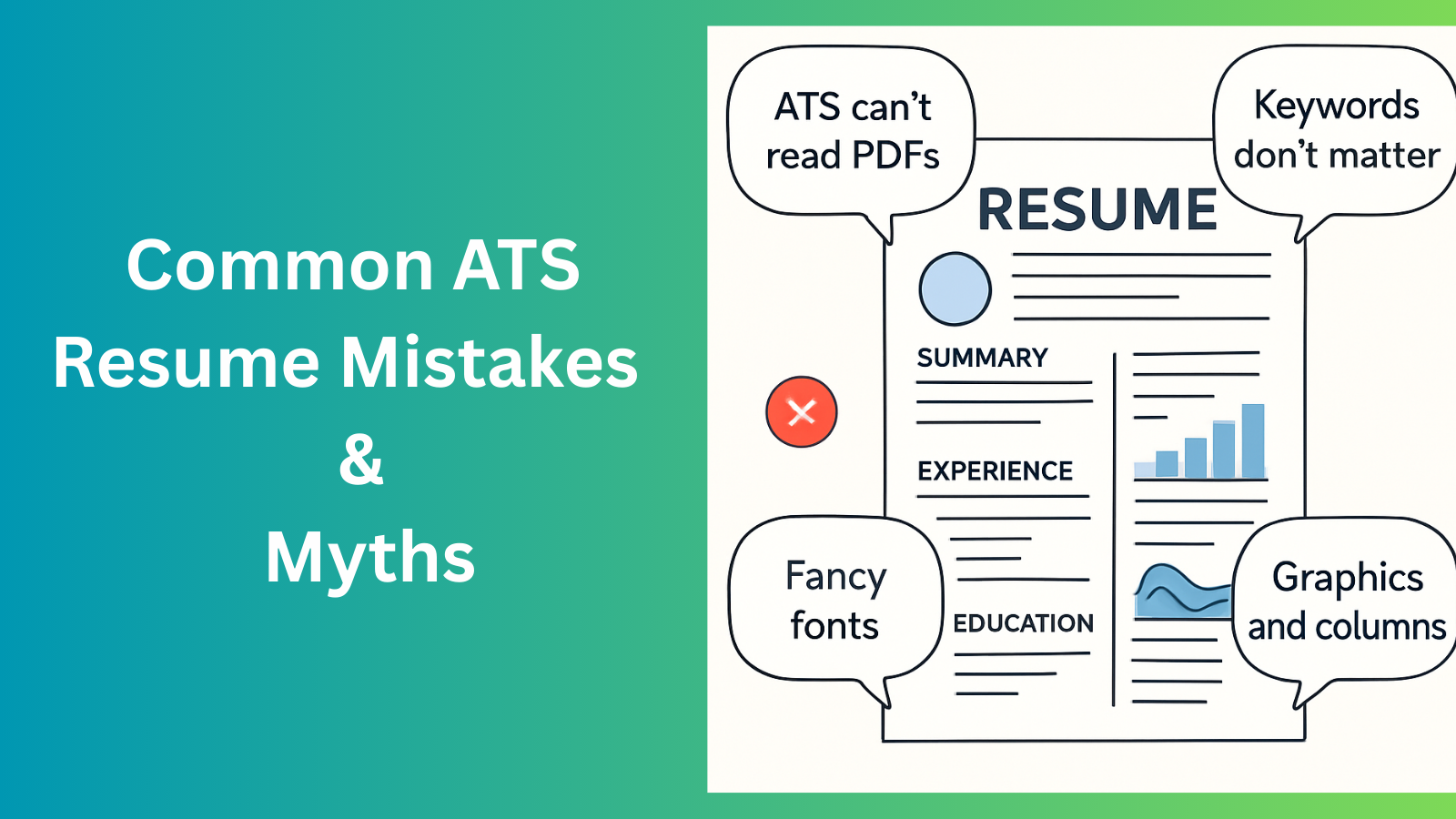
Many job seekers believe that their resume is rejected by a mysterious system before any human sees it. This belief often leads to confusion about Application Tracking System (ATS) and how they actually work.
In reality, ATS software is designed to help recruiters manage and filter large volumes of applications. However, certain mistakes and misconceptions about ATS can reduce your chances of getting noticed.
Understanding the common ATS resume mistakes and myths can help you optimize your resume so it passes automated screening and still appeals to human recruiters.
By end of this you”ll know
Common Myths About ATS Resumes
If you’ve ever stared at a job posting and wondered why your perfectly crafted resume never gets a callback, you’re probably running into common myths about ATS optimization. These misconceptions can turn a strong candidate into a ghost in the system.
In this guide we’ll bust the biggest myths, give you a step‑by‑step checklist, and show how AI tools can turn the tables in your favor There are many misconceptions about how ATS systems work. These myths often lead candidates to make poor optimization decisions.
1. ATS Automatically Rejects Your Resume
One of the most common misconceptions about Applicant Tracking Systems is that they automatically reject resumes without any human involvement. In reality, most ATS platforms are designed to organize and rank applications, not to permanently reject candidates.
How ATS Actually Handles Resumes
When you submit a resume through an online application, the ATS stores your information in a database. The system then analyzes the resume based on factors such as:
- Keywords related to the job description
- Skills and qualifications
- Job titles and experience
- Resume structure and sections
Instead of rejecting resumes outright, the ATS usually sorts and ranks candidates based on relevance. Recruiters can then review the top results and decide which candidates move forward in the hiring process.
2. You Need 100% ATS Score
Many resume optimization tools show a percentage-based ATS score, often encouraging candidates to increase your ATS score, aim for 100% compatibility. However, in reality, a true 100% ATS score is rare and not always meaningful.
Most hiring systems do not generate a universal “ATS score” the way online resume checkers do. Instead, an Applicant Tracking System evaluates resumes using different algorithms depending on the company, the role, and the specifics software being used.
Trying to reach a perfect score often leads to over-optimization, which can hurt your resume.
Common problems include:
- Keyword stuffing
- Repeating the job description verbatim
- Adding irrelevant skills just to increase the score
- Making the resume sound unnatural
3. Fancy Resume Designs Improve Your Chances
Many job seekers believe that a visually creative resume will help them stand out from other applicants. While design can be useful in certain creative industries, fancy resume designs do not necessarily improve your chances of getting through an Application Tracking System (ATS)
Why Complex Designs Can Hurt ATS Performance
ATS software is designed to read and organize text-based information. When a resume contains complex design elements, the system may struggle to interpret the content correctly.
Common design elements that can cause issues include:
- Graphics and icons
- Text inside images
- Multi-column layouts
- Charts and infographics
- Decorative fonts
These elements may prevent the ATS from properly extracting important details such as your skills ,job title, or work experience.
4. ATS Scores Are the Only Thing That Matters
Believe that achieving a high ATS score is the most important factor in getting hired. While optimizing your resume for ATS can improve visibility, the score itself is not the final decision-maker in the hiring process.
ATS Scores Are Only a Screening Indicator
Most ATS resume checkers generate a score based on factors like keyword matching, formatting, and job description alignment. These scores are meant to indicate how well a resume might perform during automated screening.
However, in real hiring systems, recruiters usually search and filter candidates rather than rely on a single numerical score.
Common ATS Resume Mistakes Job Seekers Make
Many job seekers believe that simply uploading a resume is enough to get noticed. However, small mistakes in resume structure, formatting, and content can significantly reduce the chances of passing Applicant Tracking System (ATS) screening.
Understanding the most common ATS resume mistakes can help you avoid issues that prevent your resume from being properly read, ranked, or reviewed by recruiters. Even qualified candidates sometimes reduce their chances by making avoidable resume mistakes.
Many job seekers misunderstand how the ATS score works, which leads to common resume mistakes.
Using Graphics, Tables, or Complex Templates
Highly designed resumes may look visually appealing but can cause problems for ATS software.
Elements like charts, icons, and multi-column layouts often confuse resume parsing algorithms, leading to missing or incorrectly organized information.
Writing Long Paragraphs Instead of Bullet Points
Recruiters typically scan resumes quickly, and dense paragraphs make it harder to identify key achievements.
Bullet points help highlight important information and improve both ATS readability and human scanning.
Not Tailoring the Resume for Each Job
One of the biggest mistakes job seekers make is submitting the same resume for every job application.
Each role may require different skills and keywords, so tailoring your resume to match the job description can significantly improve your chances.
Ignoring Skills and Keyword Optimization
Many job seekers underestimate the importance of the skills section.
Including relevant hard skills, tools, and industry keywords helps ATS systems understand your expertise and rank your resume appropriatel
What Recruiters Look for in the First 7 Seconds
The 7-second rule refers to the short amount of time recruiters typically spend scanning a resume before deciding whether to continue reading or move on. Studies from organizations like the Ladders suggest that recruiters often spend around 6-8 seconds on an initial resume scan.
This means your resume must communicate the most important information almost immediately.
However, even with automated screening:
Relevant Job Titles and Experience
One of the first things recruiters look for during the initial resume scan is whether your previous job titles and work experience align with the position you are applying for . Both recruiters and Applicant Tracking Systems use job titles as an important signal to determine if a candidate is a potential match for the role. Recruiters quickly check whether your past roles align with the position they are hiring for.
Key Skills and Industry Keywords
One of the first things recruiters and Applicant Tracking Systems look for in a resume is the presence of relevant skills and industry-specific keywords . These keywords help ATS software understand whether a candidate’s experience aligns with the requirements of the job. Skills related to the job description are often one of the first things recruiters notice.
Quantified Achievements and Results
Resumes that show measurable results tend to stand out more.
Examples include:
- Increased sales by 30%
- Managed a team of 10 employees
- Reduced operational costs by 15%
The 70% Rule in Hiring Explained
The 70% rule suggests that candidates do not need to meet every requirement to be considered for a job. Many companies use an Applicant Tracking System to filter resumes before human review. These systems look for keyword matches and relevant experience.
However, even with automated screening:
- Recruiters rarely expect 100% keyword matches
- A resume matching most key skills is often enough to pass the initial screening
This is why tailoring your resume to include the most important keywords from the job description significantly improves your chances.
Why You Don’t Need to Meet Every Job Requirement
Job descriptions often list an ideal candidate, not a strict checklist.
Many employers prioritize candidates who demonstrate strong core skills and the ability to learn quickly.
How Recruiters Prioritize Core Qualifications
Recruiters usually focus on the most important requirements, such as:
- Key technical skills
- Relevant work experience
- Demonstrated achievements
The 70% rule highlights an important truth about job applications:
You don’t need to be a perfect match to be considered for a role.
If you meet around 70% of the key qualifications, have relevant experience, and demonstrate the ability to learn quickly, you are still a strong candidate worth applying.
Can AI Tools Like Chat GPT Create ATS-Friendly Resumes?
AI tools can assist job seekers in several ways. They can quickly generate resume drafts, suggest stronger action verbs, and help rephrase sentences to sound more professional and concise. AI can also analyze job descriptions and recommend keywords that align with the role, which can improve ATS compatibility
Benefits of Using AI for Resume Writing
AI tools can help:
- Generate resume content quickly
- Suggest relevant keywords
- Improve wording and structure
Limitations of AI-Generated Resumes
AI-generated resumes may lack personal details or unique achievements unless carefully edited. Despite these benefits, AI-generated resumes are not always perfect. They may produce content that sounds generic or lacks specific details about your accomplishments. Recruiters typically look for measurable results and real achievements, which AI cannot fully create without accurate input from the candidate.
Additionally, if many candidates rely on the same AI-generated templates or phrases, resumes can start to look very similar, making it harder to stand out.
How to Use AI Responsibly for Resume Optimization
The best approach is to treat AI as a support tool rather than a complete solution. You can use AI to generate ideas, improve phrasing, and identify keywords, but the final resume should reflect your unique experience and achievements.
Focus on customizing the content, adding measurable accomplishments, and ensuring the resume remains clear and easy for both ATS systems and human recruiters to read. When used thoughtfully, AI tools like Chat GPT can help create resumes that are both ATS-friendly and engaging for hiring managers.

Final Takeaways: Balance ATS Optimization with Human Readability
To create an effective resume, focus on both technical optimization and clear communication.
Key principles include:
- Focus on relevance and clarity
- Use ATS-friendly formatting
- Highlight achievements and measurable impact
Remember that ATS systems are only part of the hiring process. A well-structured resume that clearly communicates your skills and accomplishments will always have the best chance of getting notice
Understanding how ATS systems work can help job seekers avoid many common resume mistakes. While Applicant Tracking Systems are used to organize and filter large numbers of applications, they are not designed to replace human decision-making. Their role is mainly to identify resumes that best match the job description based on keywords, structure, and relevance.
Many candidates struggle because of simple issues such as missing keywords, complicated formatting, or submitting the same resume for every job application. At the same time, myths like needing a 100% ATS score or believing that ATS automatically rejects resumes can lead to unnecessary stress and poor optimization choices.
Author – Ayush Panthri
Connect on LinkedIn

Reviewer – Kunal Saxena
Kunal is a seasoned Technical Resume Writer with over 13 years of experience working with startups, mid-sized firms, and top global companies like Goldman Sachs and EY. He brings deep domain expertise across tech, education, insurance, e-commerce, and investment banking.
He has helped hundreds of professionals from top firms—including Apple, Meta, Google, Adobe, and Amazon — land interviews and advance their careers globally. His approach blends real-world hiring insight with high-impact resume strategy.
Kunal is an active member of Career Thought Leaders and the Resume Writing Academy, staying current with global resume trends and recruiter expectations.
Connect on LinkedIn
Related Posts
Amit got 2 Offers with our resume builder

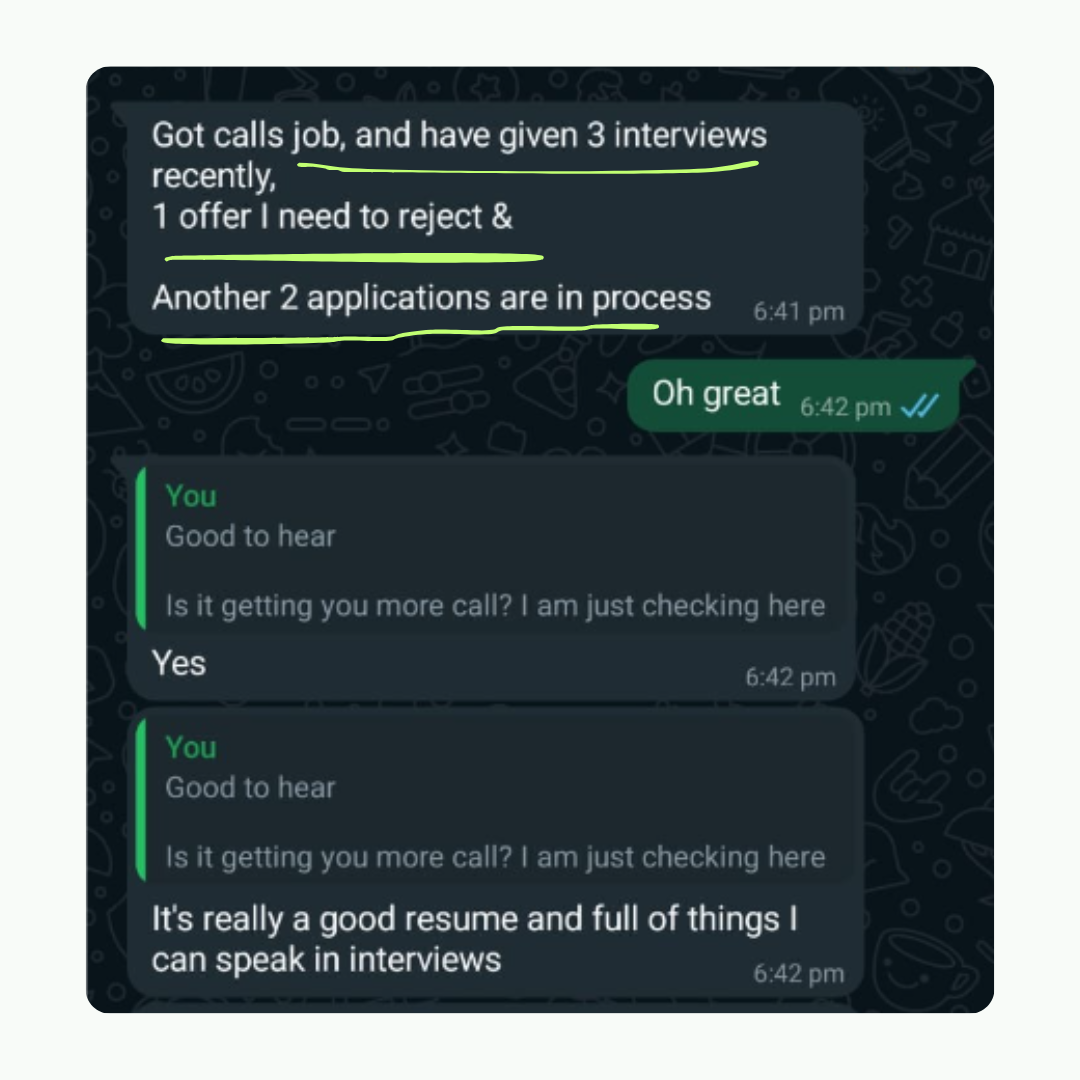
My experience was truly outstanding, I got 3-5 interview calls and 2 job offers. The resume wasn't just focused on my current job - it captured my consulting, technical and leadership skills as well. Plus this was much more affordable
Data Engineer - Deloitte