Entry-Level Software Engineer Resume Examples & Guide
 Ayush Panthri | Published: | Updated: | Reviewed By
  Kunal Saxena
If you have a few (1-2) years of software engineering experience, you might think writing a resume should be easier. In reality, it often becomes more challenging. You may have questions like ”Why am I not getting interview calls despite having experience?”, ”What do recruiters look for in a entry-level software engineer resume?”, ”How can I show my achievements instead of just listing responsibilities?”, ”What should I include to make my resume stand out from other candidates?”, ”How do I make sure my resume passes ATS screening?”
As a entry-level candidate, recruiters are no longer evaluating you based only on your education, certifications, or technical skills. They want to see how you have applied those skills in real projects, solved problems, improved systems, collaborated with teams, and contributed to business goals.
A strong resume should clearly highlight your technical expertise, project ownership, measurable achievements, and career progression. It should tell the story of how you have grown as a professional and the value you can bring to your next employer.
In this guide, you’ll review practical resume examples, how to structure a entry-level software engineer resume, showcase your experience and achievements effectively and optimize your resume for ATS systems that can help you secure more interviews.
By end of this you”ll know
Entry-Level Software Engineer Resume Examples
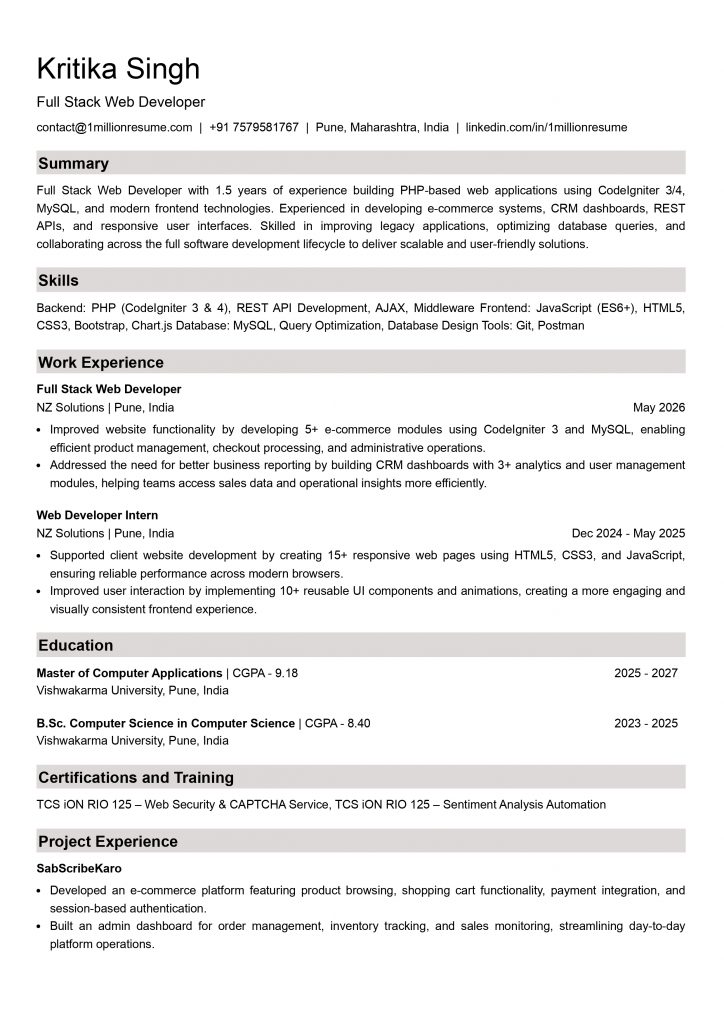
1. Full-Stack Web Developer Resume Example
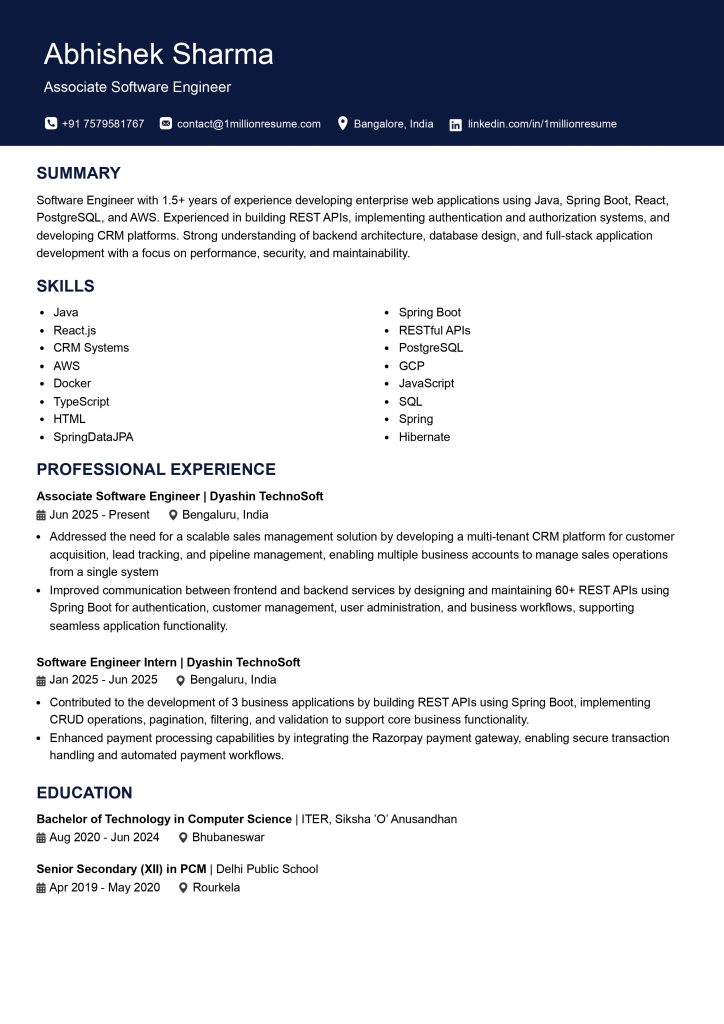
2. Associate Software Engineer Resume Example
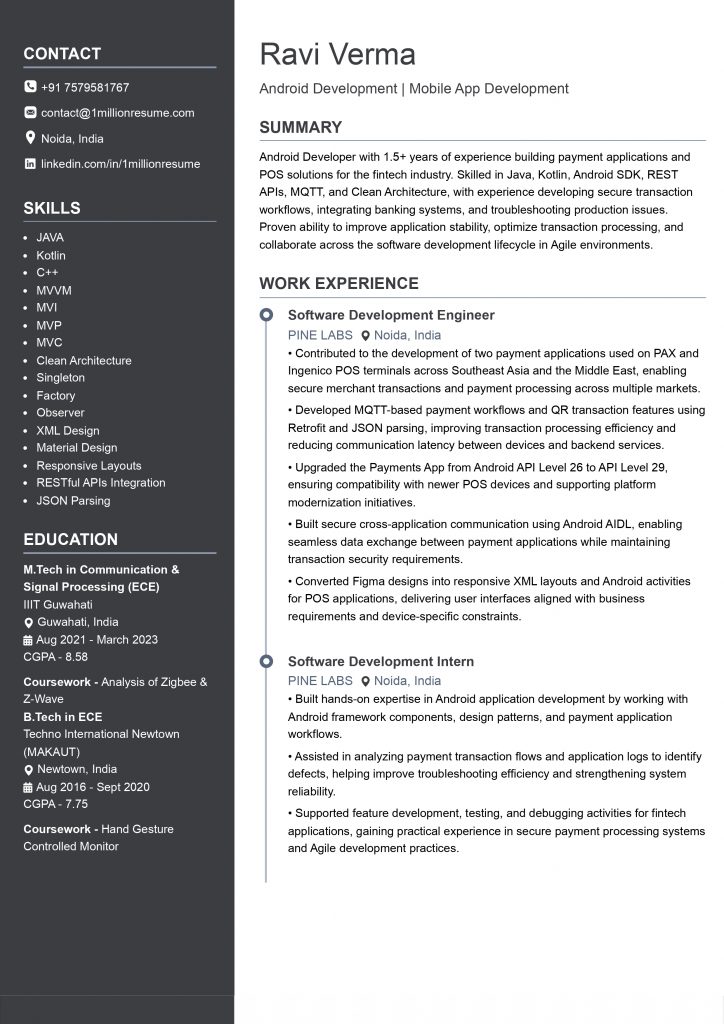
3. Mobile App Development Resume Example
Choosing the Right Resume Format for Entry-Level Software Engineers
The resume format you choose plays an important role in how recruiters evaluate your application. For entry-level software engineers, the goal is to highlight professional experience, project contributions, and measurable results in a clear and organized manner.
Which Resume Format Is Best for Entry-Level Software Engineers?
The Reverse Chronological Resume Format is the preferred choice because it clearly presents your recent experience, technical growth, and career progression.
Want to learn more about resume formats? Read our resume formats with example guide to understand which resume format recruiters prefer and how to choose the right one for your profile.
Should a Entry-Level Software Engineer Resume Be One Page or Two Pages?
This is one of the most common questions among experienced professionals. If you have 1–2 years of experience, limited project experience and few certifications a one-page resume may be sufficient.
If you have 3–5 years of experience, multiple projects, certifications, leadership responsibilities and significant achievements a two-page resume is completely acceptable.
Watch this quick video to learn the ideal resume length for software engineers.
Which Resume Templates Is Best for ATS and Recruiters?
Keep your resume simple and ATS-friendly by using a single-column layout, standard headings, readable fonts, and avoiding complex formatting such as tables, graphics, and text boxes.
Liked the resume examples above? Use our ATS-friendly resume templates to create your own resume and tailor it to your experience, skills, and target job role.
How to write an Entry-level software engineer resume
A strong Entry-level software engineer resume should clearly demonstrate your technical expertise, project ownership, achievements, and career growth.
Your resume should include the following sections:
1. Contact Information
The Contact Information section is the first thing recruiters see on your resume, so it’s important to make it clear, accurate, and professional. This section should help recruiters quickly contact you and review your online professional presence.
Your contact information should include:
| Full Name | Mohit Singh |
| Mobile Number | +91 98765 43210 |
| Professional Email Address | mohit.singh@email.com |
| Location (City and State) | Bangalore, India |
| LinkedIn Profile | linkedin.com/in/mohitsingh |
| GitHub Profile | github.com/mohitsingh |
| Portfolio Website (if available) | Portfolio: mohitsingh.dev |
Is a LinkedIn and GitHub Profile Important If You Already Have Professional Experience?
Yes. LinkedIn and GitHub help recruiters evaluate your professional background and technical expertise. Recruiters often review these profiles to verify your work experience, skills, certifications, career progression, personal projects, open-source contributions, and coding practices. Make sure both profiles are updated and consistent with the information on your resume.
Do Entry-Level Software Engineers Need a Portfolio Website?
A portfolio website is not mandatory, but it can help you stand out. It allows you to showcase featured projects, technical blogs, case studies, achievements, and GitHub repositories in one place. This is especially valuable for frontend, full-stack, mobile, and cloud engineers.
Should Your Resume and Online Profiles Match?
Yes. One of the most common mistakes professionals make is having inconsistent information across their resume, LinkedIn profile, GitHub profile, and portfolio website. Recruiters may notice differences in job titles, dates, skills, or project details. Keeping all profiles aligned helps build credibility and presents a more professional image.
2. Write a Strong Professional Summary
A professional summary is a short introduction at the top of your resume. It helps recruiters quickly understand your experience, technical skills, achievements, and areas of expertise. A clear and well-written summary can create a strong first impression and encourage recruiters to read the rest of your resume.
Why Is a Professional Summary Important?
As a entry-level software engineer, recruiters already know that you’re looking for a new opportunity. Instead of focusing on your career goals, your resume should focus on the value you can bring to the company.
A simple formula to write a strong resume summary are given below:
- 1 point about your over all career – roles you played, industries you worked etc.
- 2-3 points about your achievements / relevant works
- 1 point about your expertise / secondary skills
After implementing this formula your resume summary helps recruiters quickly understand your background, achievements, and technical strengths within a few seconds.
Entry-Level Software Engineer Summary Example:
| • Software Engineer with 2+ years of experience developing enterprise web applications and SaaS products across CRM and business automation domains using Java, Spring Boot, React, and PostgreSQL. • Built and maintained 60+ REST APIs supporting customer management, authentication, and business workflows, improving system scalability and application performance. • Developed role-based access control, real-time dashboards, and workflow automation features that enhanced user productivity and operational efficiency. • Collaborated with cross-functional teams throughout the software development lifecycle, contributing to successful project delivery and production releases. • Experienced in AWS, Docker, Git, PostgreSQL, and modern backend architecture with a strong focus on scalable and secure application development. |
Still confused about what to write in your professional summary? Watch the video below to learn a simple formula for creating a recruiter-friendly summary that highlights your experience, skills, and achievements.
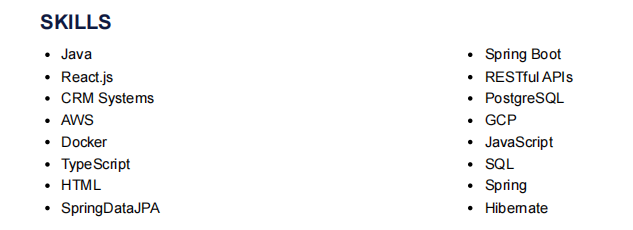
3. Highlight Technical Skills
A technical skills is the part of skill section helps recruiters quickly understand your technical expertise and determine whether you are a good fit for the role. Instead of listing every technology you have used, focus on the skills that are most relevant to your target position and that you can confidently discuss during interviews.
Your skills section should typically include:
| Programming Languages | Frameworks and Libraries | Databases | Cloud Technologies | Development Tools |
|---|---|---|---|---|
| Java Python JavaScript TypeScript C# Go Kotlin PHP C++ | Backend Frameworks: Spring Boot .NET Core Django Flask Express.js Laravel Frontend Frameworks: React Angular Vue.js Next.js | Relational Databases: MySQL PostgreSQL SQL Server Oracle NoSQL Databases: MongoDB Redis Cassandra | AWS Microsoft Azure Google Cloud Platform (GCP) Common AWS Services: EC2 S3 Lambda RDS CloudWatch | Git Postman Jira IntelliJ IDEA VS Code |
These tools demonstrate familiarity with modern software development processes.
Which Soft Skills Do Recruiters Look For?
Technical skills are important, but recruiters also look for candidates who can work well with others, communicate clearly, solve problems, take responsibility for their work, and adapt to new challenges. These skills help software engineers collaborate effectively and succeed in real-world projects.
Common soft skills include:
- Problem Solving
- Communication
- Team Collaboration
- Analytical Thinking
- Time Management
- Leadership
- Stakeholder Management
- Adaptability
Where Should the Skills Section Be Placed on a Resume?
For entry-level software engineers placing technical skills near the top helps recruiters quickly identify whether you match the role’s requirements before reviewing your experience.
Want to improve your Skills section? This video covers the best way to organize your skills, where to place them on your resume, and how to showcase your expertise effectively.
4. Work Experience
The Work Experience section is the most important part of a entry-level software engineer resume. Recruiters spend more time reviewing this section than any other because it shows how you have applied your technical skills, contributed to projects, solved problems, and delivered results in real-world environments.
What Should Be Included in the Work Experience Section?
For each role, include:
- Job Title
- Company Name
- Employment Dates
- Location (Optional)
- 4-6 achievement-focused bullet points for entry-level work experience.
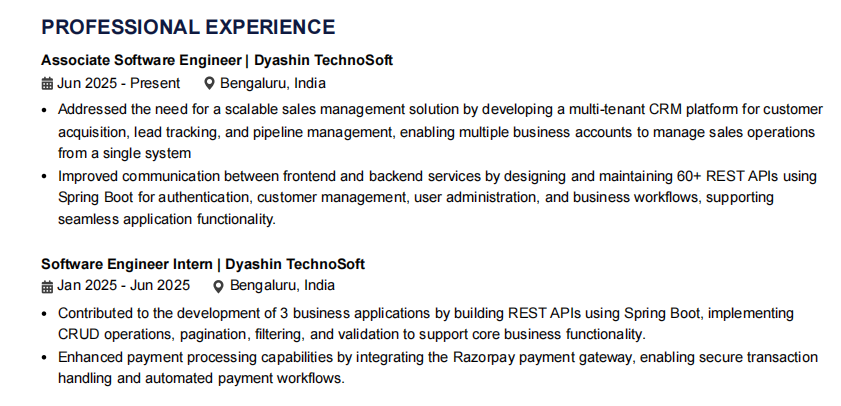
One of the best ways to write strong experience bullet points is by using the CAR Formula:
Challenge → What problem needed to be solved?
Action → What did you do?
Result → What was the outcome?
Include Metrics Whenever Possible – Numbers make your achievements more credible and easier for recruiters to understand.
After applying the CAR formula, your work experience section may look like this on your resume:
Watch this video to learn how to write achievement-focused work experience bullet points using the CAR formula and measurable results.
5. Write the Education Section
If you have a few years of professional experience, recruiters focus more on what you’ve accomplished in your career than on your academic record. However, your Education section should still be included to show your qualifications and educational background.
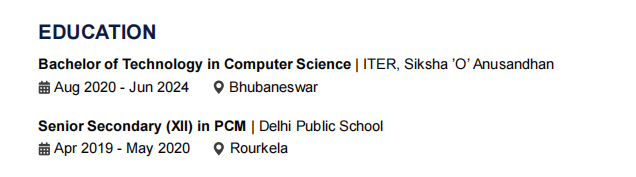
Your education section should be concise and include:
- Degree Name
- Specialization
- College or University Name
- Graduation Year
- CGPA or Percentage
Should I Include my Academic Projects?
Entry-level professionals can remove academic projects and coursework from their resumes, especially if they have relevant professional experience. However, you may keep them if they are highly relevant to your target role or demonstrate unique technical expertise.
Should I Include my School Education?
Class 10 and Class 12 details are usually optional for entry-level software engineers. If space is limited, focus on your highest educational qualification.
Example:
6. Showcase Projects Effectively
Should I still include projects on my resume if I already have professional experience? The answer is yes. A strong project section helps recruiters understand your technical expertise, problem-solving skills, and ability to build real-world solutions.
Focus on showcasing 2–4 projects that are most relevant to your target role. These can be professional projects, personal projects, or open-source contributions that demonstrate technical depth and business impact.
For each project, clearly explain:
- What problem was solved
- What technologies were used
- What your contribution was
- What results or impact were achieved
Using the CAR Formula (Challenge, Action, Result) can help you write stronger project descriptions and highlight your achievements more effectively.
Whenever possible, include metrics such as performance improvements, number of users, APIs developed, or time saved. These numbers help recruiters quickly understand the scale and impact of your work.
Examples:
- Developed 60+ REST APIs supporting CRM workflows.
- Reduced API response time by 35% through query optimization.
- Automated deployment pipelines, reducing release time from 2 hours to 20 minutes.
- Built dashboard modules used by 500+ internal users. Metrics help recruiters quickly understand the scale and impact of your work.

Include Achievements & Certifications Section
Why Are Achievements Important? Achievements help to demonstrate the impact of your work and highlight accomplishments beyond your daily responsibilities. They can showcase recognition, leadership, problem-solving abilities, and technical excellence that can help recruiters quickly identify your accomplishments, continuous learning efforts, and expertise in specific technologies.
Examples of achievements include:
- Employee of the Month or Star Performer awards
- Hackathon or coding competition wins
- Open-source contributions
- Successful project deliveries
- Performance or cost optimization achievements
- Technical blog publications or speaking engagements
Why Include Certifications? Certifications validate your knowledge and show your commitment to professional growth. They can be especially valuable when applying for roles that require expertise in specific technologies or platforms.
Popular certifications for software engineers include:
- AWS Certified Developer Associate
- Microsoft Azure Fundamentals
- Oracle Certified Java Professional
- Google Cloud Associate Cloud Engineer
- Certified Kubernetes Application Developer (CKAD)
If I have only one achievement, should I list it in a separate section?
If you have only one achievement, it’s usually better to include it within your Work Experience section, especially if it’s directly related to your role. If you have three or more notable achievements, consider creating a separate Achievements section to showcase them more effectively.
Should I Create a Separate Certifications Section on My Resume?
If you have either one or more than one certifications you should always create a separate Certifications section on the resume , it’s a good idea to create a separate Certifications section so recruiters can easily find them on your resume.
Where Should These Sections Be Placed? We can place it on work experience section, projects, achievements, certification and in education section. This placement allows recruiters to review your professional accomplishments before looking at your qualifications.
Include only achievements and certifications that are relevant to your target role and help strengthen your overall profile.

If you’re preparing your first software engineering resume, don’t miss our Fresher Software Engineer Resume Examples & Guide blog article packed with resume examples and expert writing advice.
Optimize Your Resume for ATS (Applicant Tracking Systems)
Before your resume reaches a recruiter, it is often reviewed by an ATS. This software looks for specific skills, keywords, and experience mentioned in the job description. If your resume isn’t ATS-friendly, it may be rejected before a recruiter ever sees it.
To improve your chances of getting shortlisted:
- Use a simple, single-column resume layout
- Include keywords from the job description
- Use standard section headings such as Skills, Work Experience, Projects, and Education
- Highlight measurable achievements in your experience section
- Keep formatting clean and consistent
The best way to pass ATS screening is to create a clear, keyword-rich resume that accurately reflects your skills, experience, and accomplishments.
If you want to learn more about the keywords and how to match with job description, read our detailed blog article where we explain everything you need to know.
What Is a Good ATS Score? While there is no universal ATS score, a score above 75% is generally considered a strong match. However, the most important factor is aligning your resume with the job requirements and showcasing relevant skills and achievements.
Frequently Asked Questions (FAQs)
How long should a Entry-level software engineer resume be?
For most entry-level software engineers, a 1–2 page resume is ideal. If you have 3–7 years of experience, multiple projects, certifications, and achievements, a two-page resume is completely acceptable. Focus on relevance rather than trying to fill space.
How many skills should I include on my resume?
Quality is more important than quantity most entry-level software engineers should include 10–20 relevant technical skills which you can confidently discuss during interviews.
How many projects should a entry-level software engineer showcase?
Generally, 2–4 high-quality projects are sufficient.
Are certifications important for entry-level software engineers?
Certifications are not mandatory, but they can strengthen your profile.
How should I explain frequent job changes?
If you’ve changed jobs frequently, focus on the achievements, skills, and career growth gained in each role. Let your experience speak for itself and discuss short tenures only if asked during interviews.
Should You Mention Career Gaps on Your Resume?
Small career gaps usually don’t require an explanation. For longer gaps, highlight productive activities such as certifications, freelance work, personal projects, or upskilling to show continued professional growth.
Author – Ayush Panthri
Connect on LinkedIn

Reviewer – Kunal Saxena
Kunal is a seasoned Technical Resume Writer with over 13 years of experience working with startups, mid-sized firms, and top global companies like Goldman Sachs and EY. He brings deep domain expertise across tech, education, insurance, e-commerce, and investment banking.
He has helped hundreds of professionals from top firms—including Apple, Meta, Google, Adobe, and Amazon — land interviews and advance their careers globally. His approach blends real-world hiring insight with high-impact resume strategy.
Kunal is an active member of Career Thought Leaders and the Resume Writing Academy, staying current with global resume trends and recruiter expectations.
Connect on LinkedIn
Related Posts
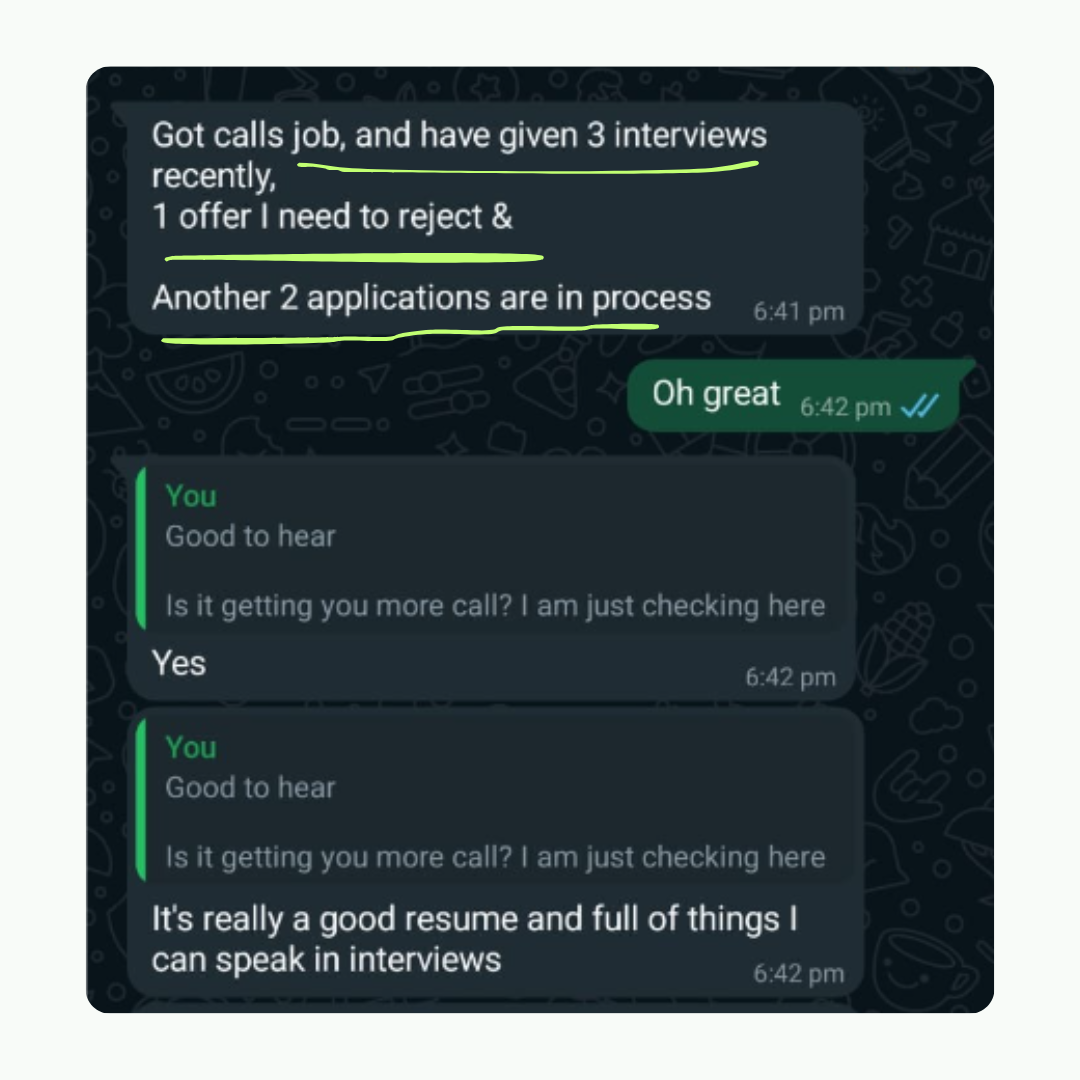
Amit got 2 Offers with our resume builder

My experience was truly outstanding, I got 3-5 interview calls and 2 job offers. The resume wasn't just focused on my current job - it captured my consulting, technical and leadership skills as well. Plus this was much more affordable
Data Engineer - Deloitte