How to Match Your Resume With a Job Description
 Ayush Panthri | Published: | Updated: | Reviewed By
  Kunal Saxena
Many job seekers send the same resume to dozens of job postings and wonder why they rarely receive interview calls. One of the most common reasons is that the resume is not aligned with the job description.
Recruiters and hiring managers look for candidates whose skills and experience closely match the requirements listed in the job posting. In addition, many companies use Application Tracking System (ATS) to scan resumes before recruiters even see them.
Matching your resume with a job description helps you highlight the most relevant skills, experience, and achievements. This increases your chances of passing ATS filters and catching the recruiter’s attention.
In this guide, you will learn how to tailor your resume effectively and align it with job descriptions to improve your chances of landing interviews.
By end of this you”ll know
What Does It Mean to Tailor a Resume to a Job Description?
Tailoring a resume to a job description means customizing your resume so that closely matches the specific requirement, skills, and responsibilities mentioned in the job posting. Instead of sending the same resume to every employer, you adjust certain sections to highlight the experience and skills that are most relevant to that particular role.
This process usually begins by carefully reading the job description and identifying important keywords, required skills, and qualifications. You then update your resume by including these keywords in sections such as the professional summary, skills, projects, and work experience.
For example, if a job description emphasizes skills like data analysis, excel, and reporting, your resume should clearly highlight any projects, coursework, or experience where you used those skills.
Difference Between a Generic Resume and a Tailored Resume
A generic resume lists all your experiences and skills without focusing on a specific job. While it may describe your background, it often fails to show how your experience fits the role you’re applying for.
A tailored resume, on the other hand, emphasizes the most relevant qualifications for that particular job, making it easier for recruiters to see why you are a strong candidate.
Why Tailoring Matters in Today’s Hiring Process
Most companies receive hundreds of applications for a single job. Tailoring your resume helps ensure that it clearly demonstrates your relevance to the position which increases the chances of being shortlisted.
How Do Recruiters Check If Your Resume Matches the Job Description?
Matching your resume to a job description is important because it helps demonstrate that your skills, qualifications, and experience align with what the employer is looking for. Recruiters often receive hundreds of applications for a single job, and they usually spend only a few seconds scanning each resume. A resume that closely matches the job requirements is more likely to stand out.
One major reason this matters is the use of Application Tracking System (ATS). These systems scan resumes for specific keywords and skills mentioned in the job description. If your resume does not include these keywords, the ATS may rank it lower or filter it out before a recruiter even sees it.
How Recruiters Evaluate Resume Relevance
Recruiters often scan resumes quickly to determine whether a candidate matches the job requirements. If the resume clearly reflects the skills and experience mentioned in the job description, it is more likely to move forward in the hiring process.
The Role of ATS in Resume Screening
Applicant Tracking Systems scan resumes for keywords, job titles, skills, and experience related to the job posting. Resumes that contain relevant keywords are more likely to be ranked higher by the system.
Benefits of Aligning Your Resume With the Job Description
Matching your resume with a job description offers several advantages:
- Improves chances of passing ATS screening
- Highlights relevant qualifications for recruiters
- Makes your resume easier to scan and understand
- Increases the likelihood of interview invitations
What Hiring Managers Look for First
Hiring managers usually look for:
- Relevant job titles
- Skills that match the job description
- Achievements that demonstrate impact
- Clear and organized resume structure
How to Match Your Resume With a Job Description
One of the most effective ways to improve your chances of getting an interview is to match your resume with the job description. Many job seekers send the same resume to multiple job postings, but recruiters are looking for candidates whose resumes clearly reflect the skills, experience, and responsibilities mentioned in the job descriptions.
In addition, many companies use Applications Tracking System (ATS) to screen resumes before a recruiter reviews them. If your resume contains the right keywords and relevant experience, it is more likely to pass this initial screening.
You can match your resume with a job description in two main ways: manually or with the help of resume tools and AI platforms. Both methods aim to improve the alignment between your resume and the employer’s requirements.
If you want to understand how resume matching impacts your ATS score, read our guide on how ATS scores work.
Matching Your Resume Manually
Step 1: Carefully Analyze the Job Description
Start by reading the job description thoroughly. Focus on the sections that describe:
- Key responsibilities
- Required skills and qualifications
- Tools or technologies used in the role
- Preferred experience or certifications
These details help you understand what the employer experts from candidates.
Step 2: Identify Important Keywords
Job descriptions often include keywords that describe the skills and qualifications needed for the role. These keywords may include:
- Technical skills
- Software tools or technologies
- Industry-specific terms
- Certifications or qualifications
For example, if the job description mentions project management, data analysis, or customer support, these keywords should appear in your resume if they accurately reflect your experience.
Step 3: Compare the Job Description With Your Resume
Next, review your current resume and compare it with the job description. Ask yourself:
- Do my skills match the requirements listed in the job posting?
- Are the relevant tools or technologies included in my resume?
- Do my past experiences reflect similar responsibilities?
This comparison helps you identify areas where your resume can be improved or updated.
Step 4: Update Key Resume Sections
Once you identify the gaps, update important sections of your resume.
Resume Summary
Adjust your summary to highlight the skills and experience most relevant to the job.
Skills Sections
Include the key skills mentioned in the job description.
Experience Section
Rewrite bullet points to emphasize achievements that demonstrate the required skills.
For example:
Generic bullet point:
- Managed marketing campaigns.
Tailored bullet point:
- Managed digital marketing campaigns that increased website traffic by 40% using SEO and social media strategies.
Step 5: Prioritize Relevant Information
Place the most relevant skills and experiences near the top of your resume. Recruiters often spend only a few seconds scanning resumes, so important information should be easy to find.
Matching Your Resume Using AI Tools- Fast & Easy
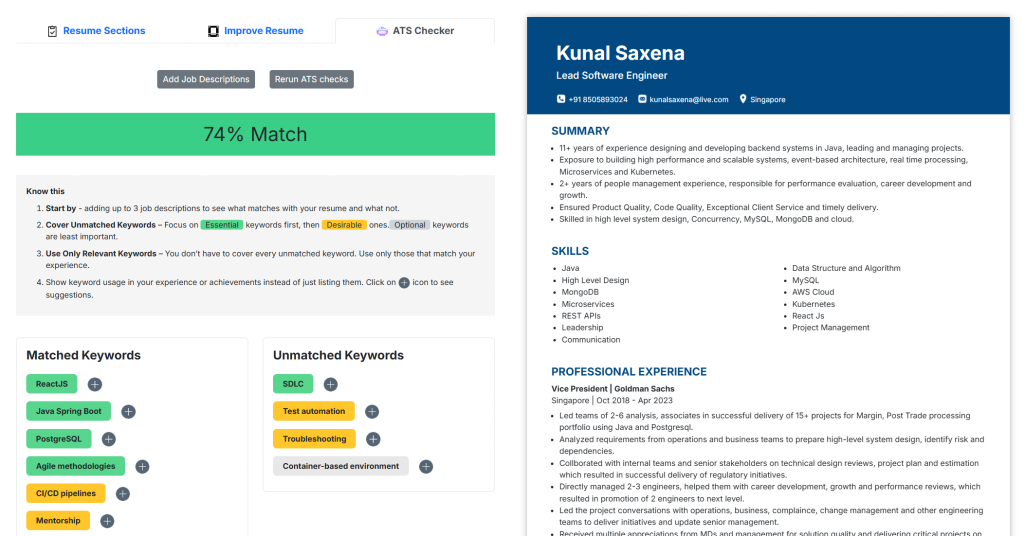
Resume optimization tools can help speed up the process of matching your resume with a job description. These tools analyze both documents and provide suggestions for improvement.
Step 1: Upload Your Resume and Job Description
Most resume scanning tools allow you to:
- Upload your resume
- Paste the job description
- Run an analysis
The tool then compares the two documents to identify how closely they match.
Step 2: Review the Keyword Analysis
After analyzing your resume, the tool may show:
- Missing keywords from the job description
- Skills mentioned in the job posting but not included in your resume
- Suggestions for improving alignment
These insights help you understand how well your resume matches the job requirements.
Step 3: Update Your Resume Based on Suggestions
Use the suggestions to improve your resume by:
- Adding relevant keywords
- Adjusting skill descriptions
- Updating experience bullet points
However, avoid adding keywords that do not reflect your actual experience. The goal is to improve alignment while maintaining accuracy.
Step 4: Recheck Your Resume Match Score
After making updates, run the analysis again to see if your resume matches the job description more closely. A higher match score usually indicates better keyword alignment and relevance.
Manual Matching vs Using Resume Tools
Both approaches have advantages and limitations.
Manual matching allows you to carefully analyze the job description and customize your resume in a more personalized way. However, it can take more time.
Using resume tools is faster and can quickly identify missing keywords or formatting issues. However, these tools may provide generic suggestions that still require manual editing.
For the best results, many job seekers combine both methods using tools for keyword analysis and manual editing to ensure the resume accurately reflects their experience.
Watch our Demo Video showing Fast & Easy Resume Job Description Matcher in our AI Resume Builder Tools.
Tools That Help Match Your Resume With a Job Description
Several tools can help you compare your resume with a job description and identify missing keywords, skills, or formatting issues. These tools analyze both documents and provide suggestions to improve your resume’s relevance for the role.
Resume Scanners and ATS Checkers
Resume scanners and ATS checkers are tools designed to help job seekers evaluate how well their resumes match a specific job description. These tools simulate how an Applicant Tracking System (ATS) might analyze your resume by checking factors such as keywords, formatting, and relevance to the job posting.
While they are not identical to the systems used by employers, they can still provide helpful insights for improving your resume.
Resume scanners are software tools that compare your resume with a job description and identify how closely the two match. They analyze elements such as:
- Keywords related to skills and job responsibilities
- Formatting and structure
- Presence of important resume sections
- Relevance of experience to the job description
Based on this analysis, the tool usually generates a match score or optimization suggestions.
How Resume Matching Affects our ATS Scores
Resume matching plays an important role in determining your ATS (Application Tracking System) score. ATS software compares your resume with the job description to measure how closely your skills, experience, and keywords align with the employer’s requirements.
When your resume matches the job description, it can improve your ATS score and increase the chances of your resume being shortlisted.
How ATS Evaluates Keyword Relevance
ATS systems analyze how closely the keywords in your resume match those in the job description.
Why Stronger Alignment Improves ATS Scores
Resumes that closely match the job description often receive higher relevance rankings within ATS systems.
Example: How ATS Scores Change After JD Matching
When a resume is updated to include relevant skills and keywords from the job description, the ATS score often increases because the content is more closely aligned with the role.
Overall Resume Relevance
ATS scoring is often based on how well the entire resume reflects the job description, including responsibilities, technical skills, and industry terminology.
Keyword Placement in Important Sections
Keywords placed in sections like skills, summary, experience, and projects can help ATS systems easily identify your qualifications and improve your score.
Example of Matching a Resume to a Job Description
Understanding how to match your resume with a job description becomes easier when you look at a simple example.
Job Description (Key Requirements)
Suppose a company is hiring a Digital Marketing Executive and the job description mentions these requirements:
- SEO and keyword research
- Google Analytics
- Social media marketing
- Content creation
- Campaign performance analysis
| Resume Before Matching | Resume Before Matching |
|---|---|
| A resume might list skills like: 1. Marketing 2. Social media 3. Writing blog 4. Data analysis Although the candidate has relevant experience, the resume does not clearly use the same keywords as the job description. | After tailoring the resume to the job description, the skills section might look like this: 1. Search Engine Optimization (SEO) and the keyword research 2. Google Analytics for campaign tracking 3. Social media marketing and content creation 4. Campaign performance analysis and reporting |
Why This Improves Resume Matching
The resume becomes easier for ATS systems and recruiters to evaluate.
Important keywords from the job description are included.
Skills and tasks are aligned with the employer’s requirements.
Matching your resume with the job description means adjusting your wording, highlighting relevant skills, and using the same important terms used by the employer . This increases your ATS score and the chances of passing ATS screening and getting noticed by recruiters.
Key Takeaways:
- Always tailor your resume for each job application. A customized resume shows recruiters that your experience directly fits the role.
- Carefully analyze the job description first. Identify key responsibilities, required skills, and important keywords before editing your resume.
- Use relevant keyword naturally. Include skills, tools, and industry terms from the job description without forcing them into the content.
- Highlight the most relevant experience and achievements. Focus on accomplishments that clearly demonstrate your ability to perform the job.
- Aligns job titles, skills, and responsibilities. This helps recruiters and ATS systems quickly recognize that you are a strong match.
- Improve readability and structure. Clear sections, concise bullet points, and organized formatting make your resume easier to scan.
- Use AI tools or resume scanners for additional insights. These tools can help identify missing keywords and improve alignment with the job description.
- Avoid keyword stuffing. The goal is to demonstrate genuine relevance, not simply increase keyword count.
- Focus on measurable results whenever possible. Quantified achievements make your experience more credible and impactful.
- Small adjustments can make a big difference. Even minor edits to wording, skills, or bullet points can significantly improve how well your resume matches a job description.
Author – Ayush Panthri
Connect on LinkedIn

Reviewer – Kunal Saxena
Kunal is a seasoned Technical Resume Writer with over 13 years of experience working with startups, mid-sized firms, and top global companies like Goldman Sachs and EY. He brings deep domain expertise across tech, education, insurance, e-commerce, and investment banking.
He has helped hundreds of professionals from top firms—including Apple, Meta, Google, Adobe, and Amazon — land interviews and advance their careers globally. His approach blends real-world hiring insight with high-impact resume strategy.
Kunal is an active member of Career Thought Leaders and the Resume Writing Academy, staying current with global resume trends and recruiter expectations.
Connect on LinkedIn
Related Posts
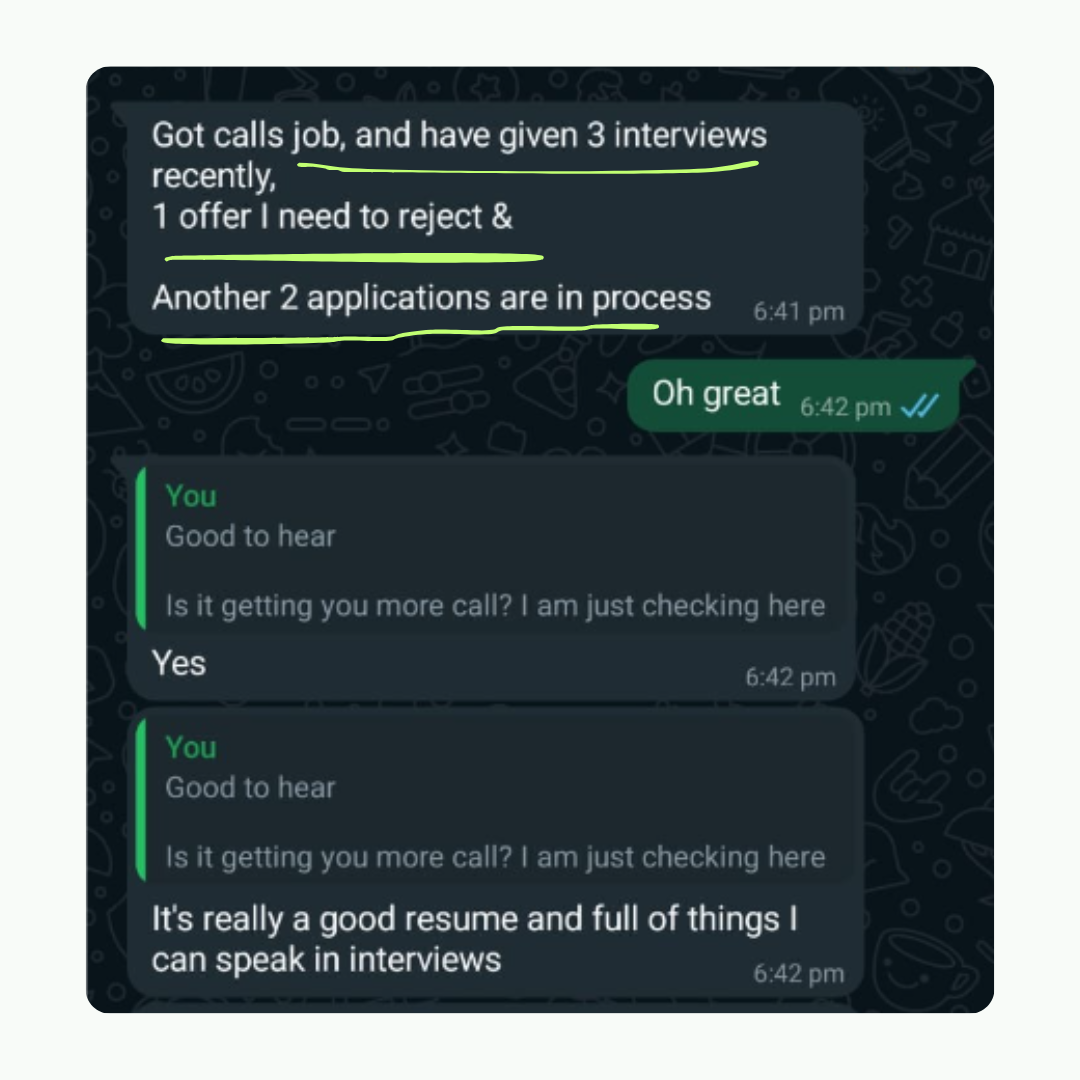
Amit got 2 Offers with our resume builder

My experience was truly outstanding, I got 3-5 interview calls and 2 job offers. The resume wasn't just focused on my current job - it captured my consulting, technical and leadership skills as well. Plus this was much more affordable
Data Engineer - Deloitte