Resume Experience Section Guide
 Ayush Panthri · 9 min read

The work experience section is one of the most important parts of your resume. It helps recruiters understand what work you have done, the skills you have used, and the results you have achieved. Instead of simply listing your job duties, focus on showing your impact with clear examples and measurable achievements. If your experience section can clearly highlight your value to employers, improves your ATS score and increase your chances of getting shortlisted for interviews.
In this guide, you will learn how to write an effective work experience section, what information to include, how to showcase achievements with metrics, optimize your content for ATS, handle employment gaps, and use AI tools to improve your resume without making it sound generic.
By end of this you”ll know
How do I add experience on my resume?
Your resume work experience section highlights your professional employment background. You can showcase relevant experience across your resume summary, work experience, and project sections.
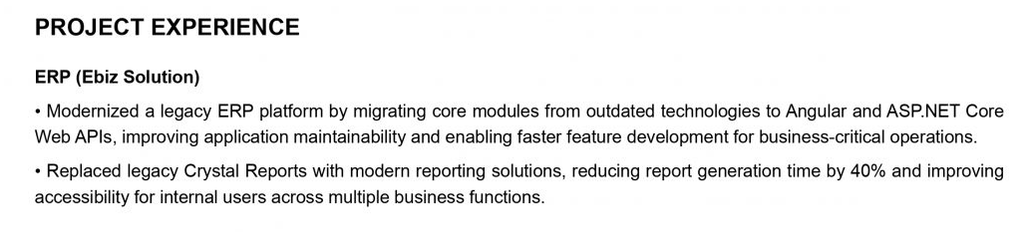
1. Resume Summary – The Resume Summary is a short introduction at the top of your resume. By including work experience in resume summary section provides a quick overview of your background, experience, and key skills to the recruiters. You can see it clearly in the given below example.

2. Work Experience – The Work Experience section shows your professional jobs history and responsibilities. It explains where you worked, what you did, and the results you achieved from your work in the company. You can see it clearly in the given below example.

3. Projects – The Projects section highlights your practical work completed outside the regular employment, such as academic, personal, freelance, or portfolio projects. It helps demonstrate your skills and hands-on experience to your recruiters. You can see it clearly in the given below example.
How to Make Your Resume Work Experience Stand Out
The Work experience section should not just list your daily tasks. Recruiters spend more time reviewing this section than any other because it shows how you have applied your technical skills, contributed to projects, solved problems, and delivered results in real-world environments. One of the best ways to write strong experience bullet points is by using the CAR Formula:
Challenge → What problem needed to be solved?
Action → What did you do?
Result → What was the outcome?
Include Metrics in your work experience bullet points whenever possible because numbers make your achievements more believable and easier for recruiters to understand your working background.
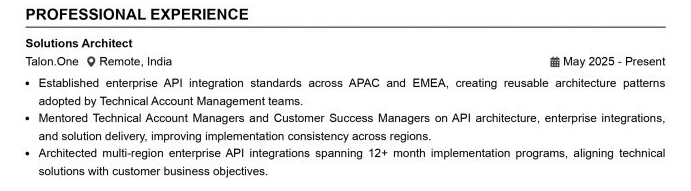
After applying the CAR formula, your work experience section may look like this on your resume:
Watch this video to learn how to write achievement-focused work experience bullet points using the CAR formula and measurable results.
Include Relevant Keywords – You can add target keywords to your experience section because many recruiters use ATS (Applicant Tracking Systems) to scan resumes. If important keywords that employers are looking for are missing, your resume may be rejected by both the ATS and the recruiter.
If you want to learn more about the keywords and how to match with job description, read our detailed blog article where we explain everything you need to know.
How to Handle Employment Gaps on a Resume
Employment gaps are common and do not automatically make your resume weak. Whether you took time off for family responsibilities, personal reasons, education, health, travel, or career development, a gap in your employment history does not hurt your chances of getting hired. The important key is to present your experience clearly, honestly, and confidently.
1. Focus on Your Strengths – Your resume is designed to showcase your skills, experience, and achievements. Instead of drawing attention to employment gaps, focus on highlighting the value you can bring to an employer. They are usually more interested in your qualifications and accomplishments than in a gap between jobs.
2. Choose the Right Resume Format – If you have a employment gap you can consider using a combination resume format. This format highlights your skills, accomplishments, and relevant experience before listing your work history. It helps employers focus on what you can do rather than when you worked.
3. Include Productive Activities During the Gap – If you spent your time learning new skills, freelancing, volunteering, studying, earning certifications, or working on personal projects, include those experiences on your resume. These activities show that you remained active and continued to develop professionally.
4. Be Ready to Explain the Gap – You do not need to explain employment gaps on your resume in detail. However, employers may ask about them during interviews. Keep your explanation brief, honest, and professional. Focus on what you learned or accomplished during that period.
5. Stay Positive – When discussing about your employment gap, avoid apologizing or sounding defensive. Instead, focus on your readiness to return to work and the skills and experiences you can bring to the role. Employers want to know what you can contribute now and in the future.
6. Always Be Honest – Never change employment dates or try to hide a gap by providing inaccurate information. Honesty builds trust with the employers a simple and straightforward explanation is usually enough.
How to Present Non-Traditional Work Experience
If you have limited professional experience then activities like volunteering, internships, freelance work, and personal projects can still demonstrate your knowledge, skills, and potential to employers. This is especially important for students, recent graduates, career changers, and professionals returning to work after a break.
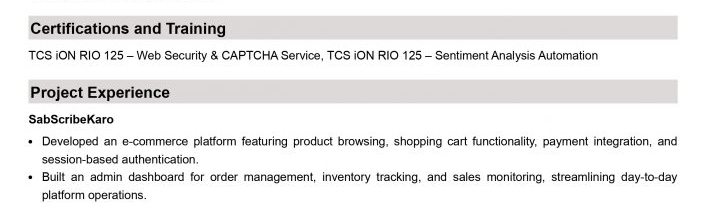
Students and Recent Graduates – If you do not have much professional work experience, focus on other activities that demonstrate your skills and knowledge, such as: Leadership roles in clubs or organizations, Internships, Academic projects, Personal projects, Freelance work, Volunteer experience, Part-time jobs and Relevant coursework.
Example:
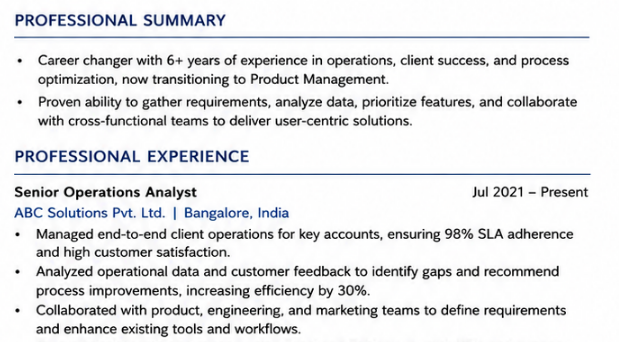
For Career Changers – If you are changing your careers, do not ignore your previous experience. Instead, focus on the transferable skills that can help you succeed in your new field. For example, skills such as: Project management, Customer service, Client relationship management, Communication, Problem-solving, Data analysis, Team collaboration. These skills are valuable across many industries and roles it show employers how your previous experiences have prepared you for your new career path.
Example:
How to write Experience with AI
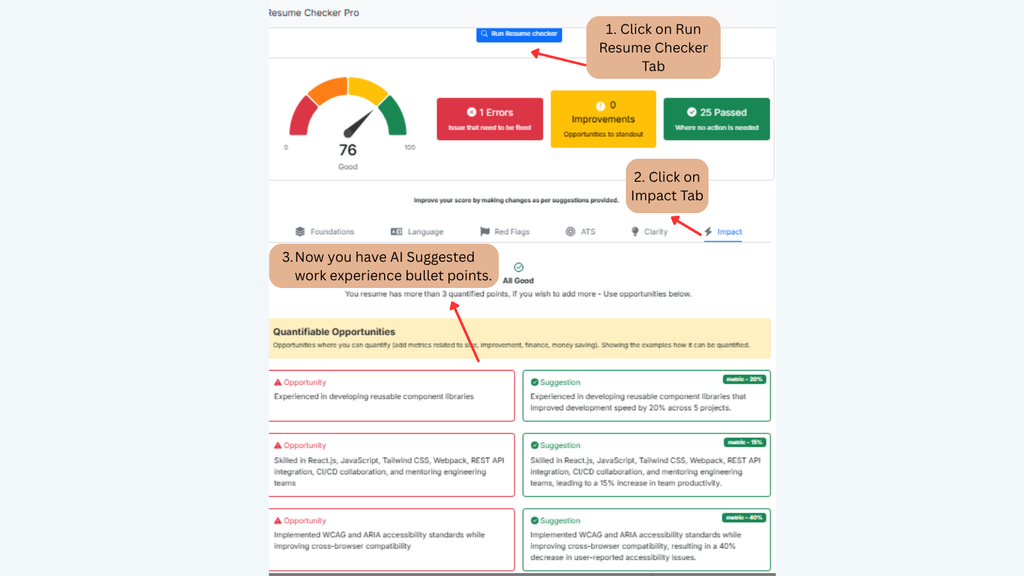
In our AI Resume Builder, you can write your work experience more easily with the help of AI. Simply import your resume into our tool and run the Resume Checker. It will provide AI suggestions for work experience bullet points that are relevant to your profile and also suggest areas where you can quantify your achievements.
Before copying and pasting these AI suggestions directly into your resume, remember that AI does not know your experience fully. Use AI as a starting point, read each suggestion carefully, and personalize it in your own words. Most importantly, review and update the metrics to make sure they are accurate and reflect your actual experience.
Work Experience on a Resume: What to Avoid
Here are some common mistakes made by experienced professionals which can weaken their resume with poorly written experience sections and how to fix them.
1. Only Listing Job Responsibilities
Many people simply describe their daily duties. But you can try to highlight your results and achievements whenever possible in your bullet points.
Bad Example: Responsible for managing a team.
This tells recruiters what your role was, but not what you achieved.
Better: Managed a team of eight analysts and improved reporting processes, reducing reporting time by 25%.
2. Using the Same Resume for Every Job
A resume should be tailored to the job you are applying for. You do not need to create a completely new resume every time, But you should prioritize the experience, skills, and achievements most relevant to the job description. A targeted resume is usually more effective than a generic one.
3. Overusing Keywords
Keywords are important, especially for Applicant Tracking Systems (ATS). But do not repeat the same keyword unnecessarily. For example, adding “Python” five times to one job description does not make your resume more relevant. Use keywords naturally where they describe actual work and skills.
4. Letting AI Write Everything
AI can help improve wording but if you simply copy AI-generated bullets, your resume may become generic and may contain achievements you never actually delivered. Use AI as a writing assistant, but make sure every statement reflects your real experience to the employers.
5. Adding Fake Metrics
Adding impressive numbers may be good, but never include information that is not accurate. Do not invent: Revenue figures, Percentages, Customer numbers, Performance improvements. If you do not know the exact numbers, describe the impact honestly and clearly because recruiters value accuracy more than exaggerated claims.
Frequently Asked Questions (FAQs)
How many bullet points should I include for each job?
5 – 8 Points for Current Job
4 – 6 Points for Past Jobs
1 – 2 Points for Early Jobs
3 – 5 Points for Freshers
Should I include achievements or awards in my work experience?
Yes, if they are relevant. A significant achievement can often be stronger when included directly within the experience where it happened.
For example: Led a process automation initiative that reduced monthly reporting time by 40%.
Major professional awards can also have a separate Awards or Achievements section if they deserve additional visibility.
How do I write a resume without work experience?
If you have no professional experience, focus on evidence of your skills. You can use: Internships, Projects, Freelance work, Volunteer experience, Academic work, Leadership activities, Relevant coursework. For freshers, the Projects and Internship sections can play a role similar to professional experience by demonstrating practical skills.
Where should I place the experience section on my resume?
For most experienced professionals, the experience section should appear prominently after the summary or professional profile. For freshers, the order can vary depending on the strength of their internships and projects.
If your projects are more relevant than your limited work history, you may choose to give projects greater visibility. The goal is to put the most relevant evidence where recruiters will see it quickly.
I work at a client site. How should I show this on my resume?
If you are employed by one company but work for a client, clearly show the relationship.
For example:
Software Engineer | ABC Consulting
Client: XYZ Corporation
Then describe the work you actually performed. If client confidentiality applies, do not reveal restricted information. The important thing is to make your employer and client relationship clear without creating confusion about who employed you.
Author – Ayush Panthri
Connect on LinkedIn

Reviewer – Kunal Saxena
Kunal is a seasoned Technical Resume Writer with over 13 years of experience working with startups, mid-sized firms, and top global companies like Goldman Sachs and EY. He brings deep domain expertise across tech, education, insurance, e-commerce, and investment banking.
He has helped hundreds of professionals from top firms—including Apple, Meta, Google, Adobe, and Amazon — land interviews and advance their careers globally. His approach blends real-world hiring insight with high-impact resume strategy.
Kunal is an active member of Career Thought Leaders and the Resume Writing Academy, staying current with global resume trends and recruiter expectations.
Connect on LinkedIn
Amit got 2 Offers with our resume builder

My experience was truly outstanding, I got 3-5 interview calls and 2 job offers. The resume wasn't just focused on my current job - it captured my consulting, technical and leadership skills as well. Plus this was much more affordable
Data Engineer - Deloitte