Resume Summary Section Guide
 Ayush Panthri | Published: | Updated: | Reviewed By
  Kunal Saxena
A resume summary is the first and very important section of resume because when a recruiter opens your resume, they usually spend only a few seconds deciding whether to continue reading or move to the next candidate. It is a short introduction placed at the top of your resume. It gives employers a quick overview of who you are, what experience you have, what skills you have gained, and what value you can bring to the organization.
Resume summaries are clear, concise, and tailored to the job you are applying for. Rather than using a generic statement that can fit any role, customize your summary by including relevant skills, experience, and keywords from the job description. This increases your chances of getting noticed by recruiters and Applicant Tracking Systems (ATS).
In this guide, you will learn what is a resume summary ? Why it is important. How to write an effective resume summary? Common mistakes to avoid and Resume summary examples for different experience levels and Roles.
By end of this you”ll know
Why Is a Resume Summary Important?
A resume summary is one of the most valuable sections or short introduction of your resume because it tells recruiters about your profession, your work experience, projects, valuable skills and achievements you have to good fit for the role. In today’s job market recruiters often receive dozens or even hundreds of applications for a single position. Because of the large number of resumes they need to review, they may not read every resume from beginning to end during the initial screening process.
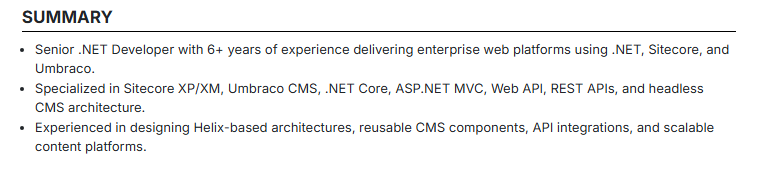
Instead, recruiters usually spend a few seconds scanning the top portion of a resume to determine whether a candidate appears relevant for the role. So your summary can help them quickly understand whether your background is relevant. In the given below image you can see clearly A well-written summary example which quickly highlights your strengths, experience, and your career goals.
Resume Summary vs. Career Objective vs. Profile Summary
There are so many candidates who are confused between a Resume Summary, Career Objective, and Profile Summary because all this are appear at the top of a resume but their meaning and purposes are different from each other.
Resume Summary
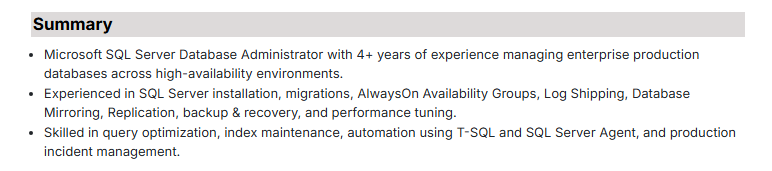
A Resume Summary is a short introduction of your overall resume that highlights your profession, most important qualifications, skills, experience, and achievements. It mainly focuses on what you have already accomplished and the value you can bring to the organization. A resume summary is best for mid-level professionals, experienced professional and for senior-level candidates.
Example: In this given below summary example, the focus is on experience, expertise, and achievements.
Career Objective
A career objective is a short, professional and specific introduction at the top of your resume that highlights your technical skills, educational background, projects, and career goals. It is mainly focuses more on your future goals and what type of opportunity you are seeking rather than your past experience. It is best for freshers, students, recent graduates, career changers and professionals returning to work after a break.
Example: In this given below career objective example, the focus is on career goals and learning opportunities.

Profile Summary
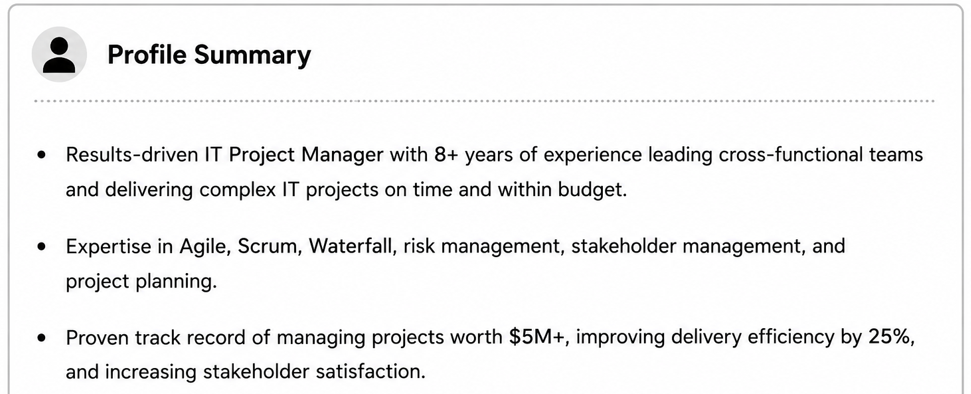
A Profile Summary is a broader professional overview that combines skills, experience, strengths, and career highlights into a concise paragraph. Many recruiters and resume writers use the terms Resume Summary and Profile Summary interchangeably because they are very similar. It is best for experienced professionals, specialists, managers and professionals with multiple skills and responsibilities.
Example: In the given below profile summary example you can see, it provides a complete snapshot of the candidate’s professional background.
Formula to write a strong Resume Summary
One of the easiest ways to write a strong resume summary is to follow this simple formula given below:
- 1 point about your overall career – roles you played, industries you worked etc.
The first sentence should introduce your professional identity. This tells recruiters your job role or profession, how many years of experience you have Industries you have worked in, your overall area of expertise.
- 2-3 points about your achievements / relevant works
After introducing yourself, showcase your most valuable accomplishments or responsibilities. Your accomplishments show employers the value you can bring to their organization. For Example: major projects you completed, teams managed, revenue growth, cost savings, process improvements.
- 1 point about your expertise / secondary skills
The final part of your summary should highlight your strongest skills and areas of specialization. This helps recruiters quickly identify whether your skills are match the job requirements.
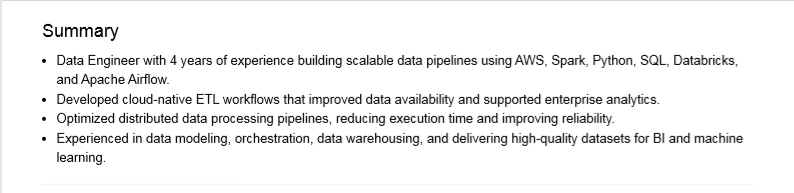
Putting this Formula Together: [Who You Are] + [Key Achievements/Experience] + [Core Expertise/Skills] your resume summary helps recruiters quickly understand your background, achievements, and technical strengths within a few seconds you can see clearly in the given example below.
Example:
Still confused about what to write in your professional summary? Watch the video below to learn a simple formula for creating a recruiter-friendly summary that highlights your experience, skills, and achievements.
How to Write a Resume Summary with AI
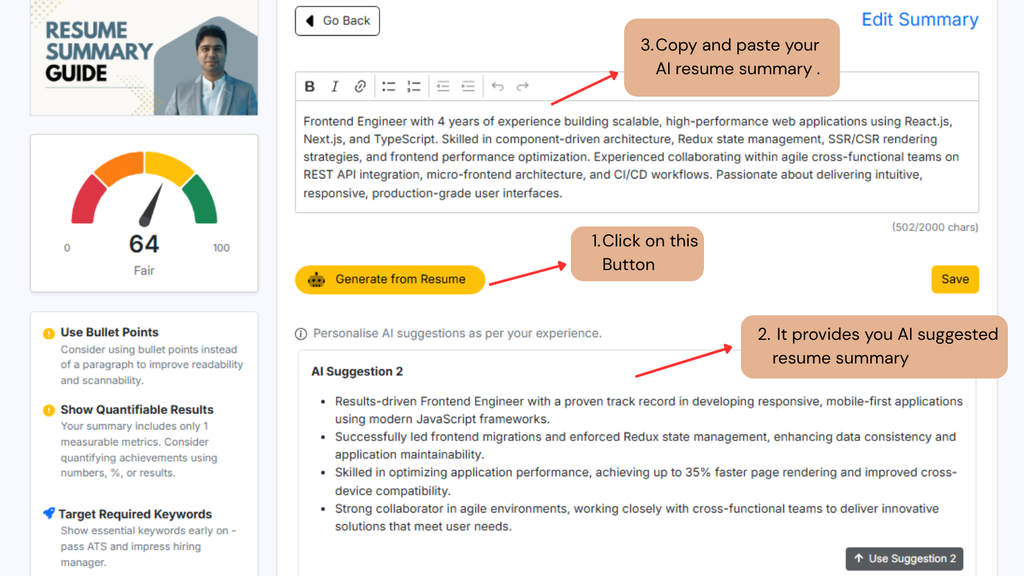
Writing a resume summary with AI is much easier by using our AI Resume Builder tool. With just one click, AI can generate a professional resume summary in seconds. You can just fill information like which role you are targeting and 2-3 job description according to your role. Then AI analyzes your information and creates a summary that follows the same proven manual formula automatically.
- 1 point about your overall career
- 2-3 points about your achievements / relevant works
- 1 point about your expertise / secondary skills
Once the summary is generated, simply review it, copy the suggested content, and paste it into the Resume Summary section of your resume. You can also make small edits to personalize it further. Using AI not only saves time but also helps you create a well-structured and impactful summary that makes your resume stand out from other applicants and leaves a strong first impression on recruiters.
Resume Summary Examples by Career Stage and Job Profile (Roles)
The best resume summary depends on your experience and your target role. Below, you’ll find resume summary examples from different professions and experience levels. Use these examples as inspiration when writing your own resume summary. Customize them to reflect your background, achievements, and career goals.
Resume Summary Example for a Recent graduate & Fresher
If you are a student, recent graduate, or someone starting your career, writing a career objective is a great first step in building your resume. A strong career objective helps employers quickly understand your education, skills, strengths, and career goals, even if you have little or no work experience.
You can copy and paste all this below example easily.
| Career Objective Copy to clipboard ✂️ Aspiring Data Analyst with hands-on experience analyzing datasets using SQL, Excel, Python, and Power BI. Experienced in data cleaning, dashboard creation, and trend analysis through internship and academic projects. Strong analytical and problem-solving skills with a passion for transforming data into actionable insights that support business decisions. |
Resume Summary Example for a Software Engineer
| Resume Summary Copy to clipboard ✂️ • Software Engineer with 2.5+ years of experience developing enterprise web applications. • Built and integrated REST APIs to enable smooth communication between frontend and backend systems. • Implemented secure authentication and authorization systems to improve application security and user access control. • Contributed to the development of CRM platforms by building scalable backend features and full-stack functionality. |
Resume Summary Example for a Senior Software Engineer
| Resume Summary Copy to clipboard ✂️ • 6+ years of experience building scalable backend systems for payment and hiring platforms. • Improved UPI payment reliability from 80% to 96% by redesigning payment workflows. • Reduced code review time by 60% through an AI-powered review assistant. |
Resume Summary Example for a Business Analyst
| Resume Summary Copy to clipboard ✂️ • Business Analyst with 3.5+ years of experience delivering business solutions through requirement gathering, stakeholder management, Agile methodologies, and process improvement. • Improved order accuracy by 35%, increased customer retention by 20%, and optimized business workflows by leveraging data analysis and user research. • Experienced in requirements gathering, business analysis, stakeholder management, product backlog prioritization, and Agile/Scrum delivery. |
Resume Summary Example for a Frontend Engineer
| Resume Summary Copy to clipboard ✂️ • Senior Frontend Engineer with 8 years of experience, including 5+ years specializing in React.js and modern JavaScript (ES6+), building scalable and high-performance web applications. • Experienced in developing reusable component libraries, optimizing frontend performance, improving accessibility, and delivering responsive user interfaces. • Improved Lighthouse performance scores by 30%+, reduced duplicate development effort by 25–30%, and decreased post-production defects by 30% through frontend optimization and engineering best practices. • Skilled in React.js, JavaScript, Tailwind CSS, Webpack, REST API integration, CI/CD collaboration, and mentoring engineering teams. |
Resume Summary Example for a Backend Software Engineer
| Resume Summary Copy to clipboard ✂️ • Backend Software Engineer with 2+ years of experience building scalable REST APIs, SaaS platforms, and distributed backend systems using Python, FastAPI, Django, Node.js, and PostgreSQL. • Experienced in designing backend architectures, optimizing system performance, and delivering production-ready cloud applications using AWS, Docker, and CI/CD. • Passionate about building secure, scalable backend systems that solve real-world business problems. |
Resume Summary Example for a Data Analyst
| Resume Summary Copy to clipboard ✂️ • Data Analyst with 3.8 years of experience in healthcare data operations, specializing in managing high-volume data pipelines processing 800,000+ records daily. • Performed data reconciliation and Root Cause Analysis (RCA) using SQL and workload automation tools to identify and resolve data quality and processing issues. • Developed Power BI dashboards and monitored system performance using Statistical Process Control (SPC), improving visibility into operational trends and data health. |
Resume Summary Example for a Cybersecurity Manager
| Resume Summary Copy to clipboard ✂️ • Cybersecurity Manager with 6+ years of experience leading Security Operations, Incident Response, SIEM engineering, and enterprise security programs across government and critical infrastructure environments. • Proven success leading cross-functional security teams, designing security policies, optimizing detection content, and translating technical risks into executive-level security strategies. • Passionate about strengthening enterprise cyber resilience through automation, continuous monitoring, and proactive threat hunting. |
Resume Summary Example for a Business Intelligence Analyst
| Resume Summary Copy to clipboard ✂️ • Business Intelligence Analyst with 4.5+ years of experience designing Power BI dashboards, analyzing business data, and delivering reporting solutions that support data-driven decision-making. • Developed interactive dashboards and automated reporting processes, improving reporting efficiency by 30% and enabling stakeholders to monitor key business KPIs more effectively. • Designed and optimized 100+ Power BI and Tableau dashboards, reducing manual reporting effort by 60% and enabling executives to monitor KPIs and business performance in real time. |
Resume Summary Example for Data Scientist
| Resume Summary Copy to clipboard ✂️ • Data Scientist with 3+ years of experience developing machine learning, NLP, and predictive analytics solutions across enterprise environments. • Experienced in designing, deploying, and monitoring production ML models using Python, PySpark, Azure, GCP, and Databricks. • Designed and deployed scalable AI applications using AWS, GCP, LangGraph, PostgreSQL, Redis, and cloud-native deployment pipelines. |
Resume Summary Example for Product Manager
| Resume Summary Copy to clipboard ✂️ • Product Manager with 5+ years of experience leading cross-functional initiatives across product operations, quality analytics, customer experience, and business operations within technology-driven organizations. • Proven ability to coordinate cross-functional teams, manage program execution, optimize business processes, and deliver data-driven initiatives supporting strategic business objectives. |
Resume Summary Example for Data Engineer
| Resume Summary Copy to clipboard ✂️ • Data Engineer with 2.5+ years of experience designing scalable ETL pipelines using Python, SQL, Spark, Azure Databricks, and Azure Data Factory. • Migrated 2,000+ Oracle and MySQL tables to Azure Data Lake, enabling reliable and scalable analytics. • Built batch and streaming data pipelines using PySpark, Structured Streaming, and Auto Loader to process large-scale datasets. |
Resume Summary Example for Engineering Manager
| Resume Summary Copy to clipboard ✂️ • Engineering Manager with 14+ years of experience leading high-performing engineering teams building AI platforms, distributed systems, and cloud-native applications. • Delivered production-scale Generative AI, RAG, and Agentic AI platforms serving 2.5M+ daily users, reducing response latency by 64% and improving search performance by 470x. • Experienced in roadmap planning, engineering execution, mentoring, architecture, production reliability, and cross functional stakeholder management |
Resume Summary Example for Solution Architect
| Resume Summary Copy to clipboard ✂️ • Solution Architect with 8+ years of experience designing enterprise SaaS, API, and cloud data integration solutions across analytics, customer data platforms, and MarTech ecosystems. • Trusted technical advisor for Fortune 500 organizations, specializing in enterprise architecture, data governance, API integrations, and cloud data platforms including Google BigQuery, Snowflake, and Databricks. • Delivered measurable outcomes including 50% faster customer onboarding, $1.5M+ annual client savings, and 100,000+ daily transactions with less than 1% failure rate |
Resume Summary Example for Principal Engineer
| Resume Summary Copy to clipboard ✂️ • Principal Engineer with 14+ years of experience designing and delivering Android Automotive and AOSP-based infotainment platforms for global automotive OEMs. • Specialized in Android Auto, Apple CarPlay, embedded Android systems, platform architecture, and vehicle connectivity, driving scalable, production-ready software solutions. • Experienced in technical architecture, cross-functional leadership, stakeholder collaboration, system optimization, and mentoring engineering teams to deliver high-quality automotive software |
Resume Summary Example for DevOps Engineer
| Resume Summary Copy to clipboard ✂️ • DevOps Engineer with 4 years of experience automating cloud infrastructure, CI/CD pipelines, and Kubernetes deployments across AWS environments. • Experienced in AWS, Kubernetes (EKS), Terraform, Docker, GitHub Actions, ArgoCD, and infrastructure automation. • Improved deployment reliability, optimized cloud infrastructure, strengthened security, and reduced operational costs through scalable DevOps practices. |
How to Optimize Your Resume Summary for ATS
Nowadays so many companies use Applicant Tracking System (ATS) to scan resumes before a recruiter reviews them. ATS software looks for specific keywords, skills, job titles, and qualifications that match the job description. If your resume summary is not optimized for ATS, your resume may be overlooked even if you are qualified for the role.
1. Use Keywords from the Job Description.
The most important ATS optimization technique is using relevant keywords from the job posting. Example: If the job description mentions: Stakeholder Management, Project Management, Agile Methodology, Scrum. Include these terms naturally in your summary if they match your experience.
2. Include Your Target Job Title.
Include the job title you’re applying for near the beginning of your resume summary, as many ATS systems look for matches between your job title and the job description.
3. Mention Your Most Relevant Skills.
Your summary should highlight the skills that are most important for the position you are applying. Focus on the skills that appear frequently in the job description. Example: For a Data Analyst role: SQL, Power BI, Excel, Data Visualization and Reporting.
4. Quantify Your Achievements
Numbers make your summary stronger and provide measurable results to the employer. Example: Increased sales by 25%, Reduced costs by 15%, Managed a team of 20 employees, Led projects worth $2 million.
If you want to learn how to identify ATS keywords and tailor your resume summary for a specific role, read our complete guide on How to Match Your Resume with a Job Description.
Common Resume Summary Mistakes
Here are some common resume summary mistakes that many job seekers make while creating resumes which reduce the effectiveness of their resume summary section.
1. Writing a Summary That Is Too Long – A resume summary should be short and easy to read. Some candidates write large paragraphs that take up too much space on the resume.
Why It’s a Problem: Recruiters usually spend only a few seconds reviewing a resume initially. A lengthy summary may be skipped.
Better Approach: Keep your summary between 3–5 concise sentences or a few bullet points that highlight your most relevant qualifications.
2. Using Generic Statements – Many resumes contain vague phrases that could apply to almost anyone. Mistake: Go-getter, Hardworking professional, Team player, Results-oriented individual.
Why It’s a Problem: These statements do not provide specific information about your experience or skills.
Better Approach: Include details about your expertise, industry experience, achievements, or technical skills.
3. Focusing Only on Responsibilities Instead of Achievements – Your summary should show what you accomplished, not just what you were responsible for. Achievements make your profile more impressive and credible.
Mistake: Responsible for managing social media accounts and marketing campaigns.
Better Approach: Managed social media campaigns that increased engagement by 40% and helped generate qualified leads.
4. Not Tailoring the Summary to the Job – Using the same summary for every job application is a common mistake.
Why It’s a Problem: Different employers look for different skills and qualifications.
Better Approach: Review the job description and include relevant skills, keywords, and experience that match the role.
5. Including Irrelevant Information – Some candidates add information that is unrelated to the position they are targeting.
Mistakes: Mentioning skills or experiences that have no connection to the job.
Better Approach: Include only information that supports your target role and demonstrates your value to employers.
Frequently Asked Questions About Resume Summaries
Can freshers include a resume summary?
Yes, But instead of resume summary they write career objective, it can highlight their education, skills, projects, internships, and career goals.
Should I write a resume summary in the first or third person?
Avoid both; write directly without using pronouns like “I,” “me,” or “he/she.
Do I need a resume summary for every job application?
No, but you should tailor it when applying for different roles.
Can I use AI to write my resume summary?
Yes, but always review and personalize the AI-generated content.
What should I avoid writing in a resume summary?
Avoid generic statements, irrelevant skills, long descriptions, and unsupported claims.
Author – Ayush Panthri
Connect on LinkedIn

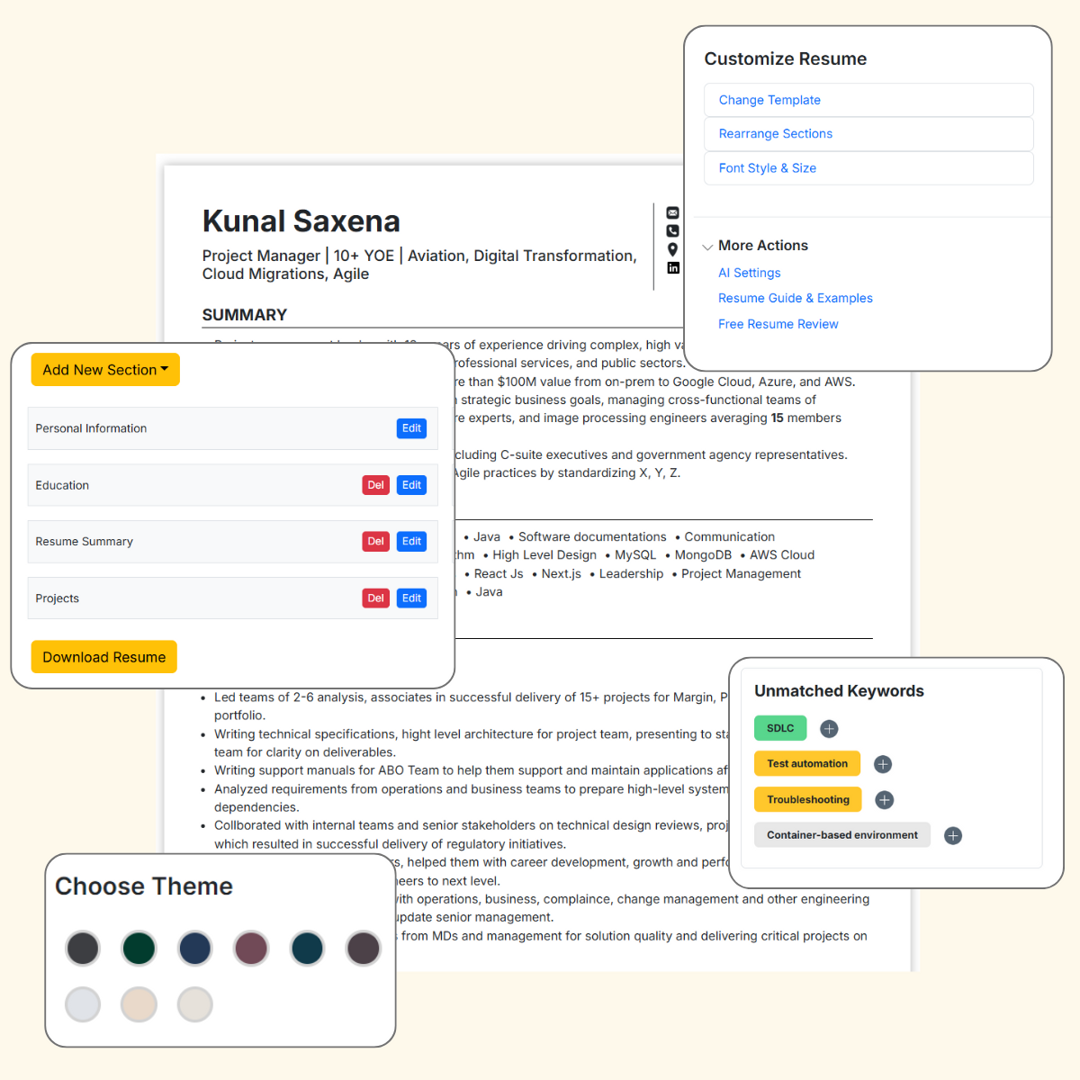
Reviewer – Kunal Saxena
Kunal is a seasoned Technical Resume Writer with over 13 years of experience working with startups, mid-sized firms, and top global companies like Goldman Sachs and EY. He brings deep domain expertise across tech, education, insurance, e-commerce, and investment banking.
He has helped hundreds of professionals from top firms—including Apple, Meta, Google, Adobe, and Amazon — land interviews and advance their careers globally. His approach blends real-world hiring insight with high-impact resume strategy.
Kunal is an active member of Career Thought Leaders and the Resume Writing Academy, staying current with global resume trends and recruiter expectations.
Connect on LinkedIn
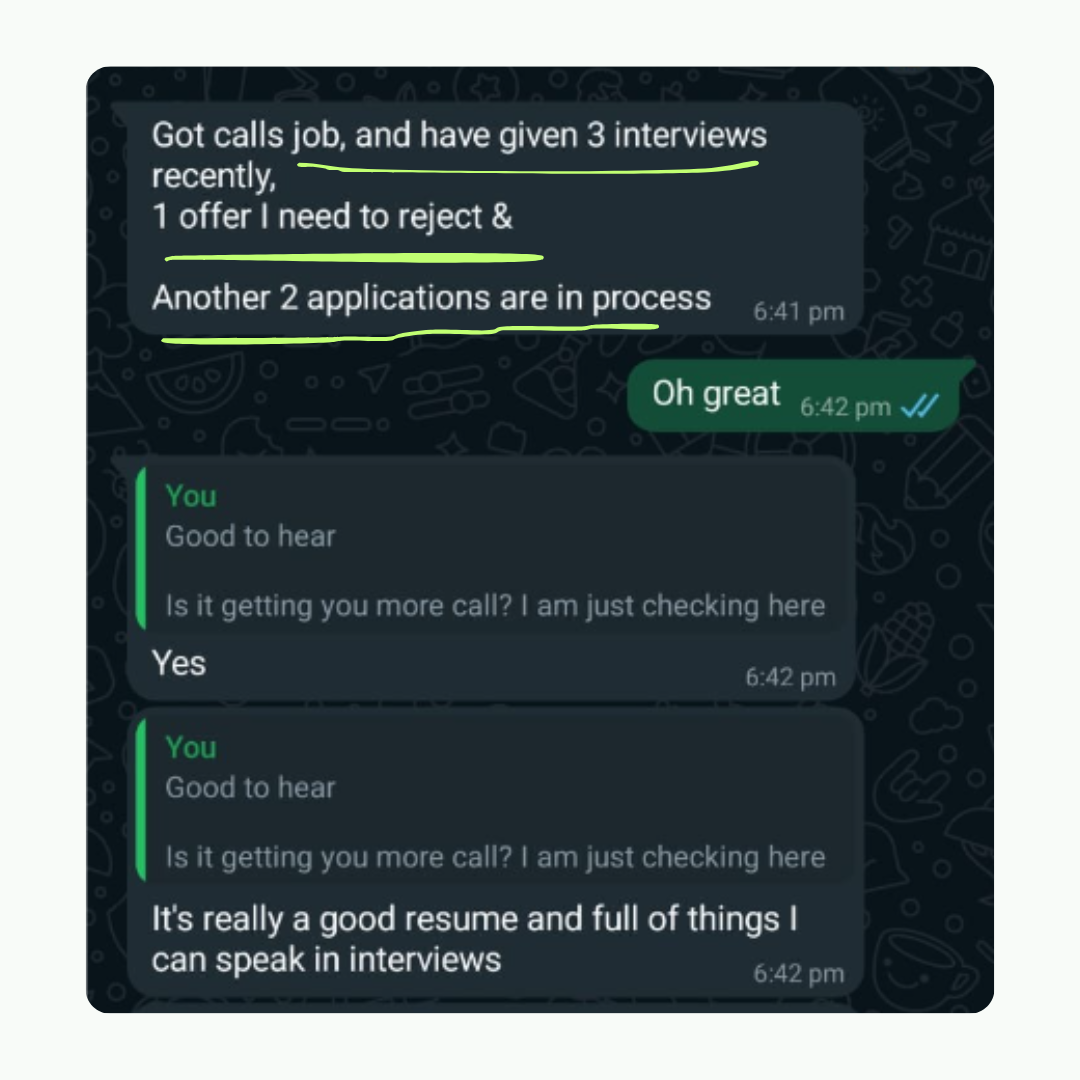
Amit got 2 Offers with our resume builder

My experience was truly outstanding, I got 3-5 interview calls and 2 job offers. The resume wasn't just focused on my current job - it captured my consulting, technical and leadership skills as well. Plus this was much more affordable
Data Engineer - Deloitte