Resume Projects Section Guide
 Ayush Panthri · 10 min read

A project section can help employers understand what you can actually do, not just what you have studied or where you have worked. If you are a fresher looking for your first job, an experienced professional, or someone changing careers, projects can showcase your skills in action. They show how you applied your knowledge, used different tools, solved problems, and worked on real tasks or challenges.
It can also help recruiters see your practical experience, especially when you have limited work experience or want to highlight your specific skills that are relevant to the job. However, simply listing project names is not enough. You need to explain what the project was about, your role, the tools or technologies you used, and the results or outcomes you achieved whenever possible.
In this guide, you will learn why projects are important on a resume, who should include them, how to choose the right projects, where to place them, and how to write effective project descriptions with examples.
By end of this you”ll know
Why Are Projects Important on a Resume?
Projects can help employers understand how you use your skills in real situations. In the given below you can see the main reasons why projects are important on a resume.
1. Projects Show Your Practical Skills – Employers are not only interested in the skills you list on your resume they also want to know how you have used those skills. Projects help you demonstrate your technical, analytical, creative, and problem-solving abilities through real work. Instead of simply claiming you have a skill, a project provides proof that you have used it.
For example:
- A marketing professional can highlight a campaign that increased website traffic or generated more leads.
- A software developer can showcase an application built using React and Node.js.
- A data analyst can show how they used SQL and Power BI to analyze data and create reports.
2. Projects Help When You Have Limited Work Experience – If you are a fresher or recent graduate, you may not have much professional experience to include on your resume. In this situation, academic projects, internships, personal projects, freelance work, or certification projects can help demonstrate your abilities. For example, a computer science graduate can showcase a full-stack application they built and explain the technologies used and their contribution to the project. This helps recruiters understand your potential even if you have little or no full-time work experience.
3. Projects Make Your Resume More Relevant – You can choose the projects that match the job you are applying and can make your resume more relevant. Recruiters wants to look for evidence that your experience matches the requirements of the role. For example, if you are applying for a Data Analyst position, a project involving SQL, dashboards, data visualization, or business reporting will usually be more relevant than an unrelated college event project. So relevant projects make it easier for recruiters to see why you are a good fit for the role.
4. Projects Show Problem-Solving and Initiative – Projects can demonstrate how you identify problems, find solutions, and take ownership of tasks. They can also show that you are willing to learn and improve your skills outside of regular coursework or job responsibilities. For example, building a personal website, creating an automation tool, contributing to an open-source project, or conducting independent research can show initiative and a proactive approach to learning these qualities are often valued by employers.
Who Should Include Projects on Their Resume?
Include Projects on their resume can be valuable for candidates at every career stage if they help demonstrate relevant skills, experience, or achievements. Here are some situations where adding projects to your resume can be beneficial.
1. Freshers and Recent Graduates – Projects are especially important for freshers because they have little or no full-time work experience. A project can show employers how you have applied your knowledge in a practical situation. Examples include: Personal portfolio projects, Final-year academic projects, Capstone projects, Internship projects, Research projects and Technical experiments. But when you describing a project, focus on your contribution, the tools or technologies you used, the problem you solved, and the results you achieved.
2. Students Applying for Internships – If you are applying for internships, projects can help to demonstrate your interest in the field and your ability to apply what you have learned. For example, a student applying for a digital marketing internship could include projects such as:
- SEO keyword research for a sample website
- Social media content planning
- Google Analytics reporting
- A mock paid advertising campaign
3. IT Professionals and Software Developers – Projects can help IT professionals to showcase technical skills, specialized knowledge, and experience with specific technologies. If you are experienced professionals, focus on projects that demonstrate your technical ownership, complexity, scale, or measurable business impact.
Examples:
- Web application development
- Cloud migration projects
- Data engineering workflows
- Machine learning solutions
- Cybersecurity assessments
4. Career Changers – Projects are especially helpful when you’re moving into a new career or industry. It can help employers to see that you have already started developing skills related to your target role. For example, a sales professional moving into business analytics could include a sales dashboard project created using Excel or Power BI. So project can help to connect your previous experience with the skills required in your new field.
5. Experienced Professionals – Experienced candidates have also benefit from including projects in their resume especially when a project highlights important achievements, leadership responsibilities, or specialized expertise. For example, an Engineering Manager might include a project that involved:
- Leading a team of 12 engineers
- Managing a cloud migration initiative
- Reducing deployment time by 40%
What Types of Projects Should You Include on Your Resume
You can include the projects that match the job you’re applying and show your skills and experience to the recruiters. Here are the most common project types you can put on your resume.
1. Academic Projects – Academic projects are completed as part of your college, university, diploma, or coursework. They are especially useful for students and freshers who may not have much professional experience. Examples: Business strategy assignments, Final-year projects, Capstone projects, Machine learning models, Software development projects, Market research studies.
2. Personal Projects – Personal projects are projects you create on your own to learn new skills, solve a problem, or build a portfolio. These projects show initiative, curiosity, and practical knowledge outside of formal education or work. Examples: Automation tools, Personal portfolio website, Expense tracker application, E-commerce website, Mobile application and Personal finance dashboard.
3. Professional Projects – Professional projects are projects completed as part of your job. They help demonstrate your technical skills, business knowledge, teamwork, and ability to deliver results. Examples: Customer retention programs, CRM implementation, Cloud migration projects, ERP deployment, Product launches and Process automation initiatives.
4. Freelance Projects – Freelance projects show that you can work with clients, manage responsibilities, and deliver results independently. Examples: Marketing consulting assignments, Website development, SEO projects, Graphic design work, Social media campaigns and Financial reporting projects.
5. Open-Source Projects – Open-source projects are especially valuable for software developers and technical professionals. They demonstrate coding skills, collaboration, problem-solving abilities, and experience working with development tools and workflows. Examples: Developer tools and libraries, GitHub contributions, Bug fixes, Feature development and Documentation improvements.
6. Research Projects – Research projects are useful for candidates in academic, scientific, technical, analytical, and business-related fields. A research project, explain the objective, research method, tools used, findings, and your contribution to the project. Examples: Healthcare data analysis, Market research studies, Consumer behavior analysis, Artificial intelligence research and Financial risk analysis.
Where Should You Put Projects on Your Resume?
The best place for your projects section depends on your experience level, career stage, and how important the projects are for the job you are applying, because the right placement should help recruiters quickly see your most relevant qualifications. Here are the most common ways to include projects on a resume.
1. Place Projects After the Education Section
If you are a student, fresher, or recent graduate, it is usually best to place your projects section after your education section. If you may have limited work experience, projects can help demonstrate your practical skills and knowledge. Keeping education and projects together makes it easier for recruiters to understand what you have learned and how you have applied those skills.
A common resume structure for freshers is given below and you can also adjust this order depending on your strengths and the requirements of the job.
- Contact Information
- Resume Summary or Career Objective
- Skills
- Education
- Project
- Internship Experience
- Certifications
- Achievements
2. Create a Dedicated Projects Section
A separate projects section is a good option when you have multiple relevant projects that you want recruiters to notice. This approach works well for:
- Students with several academic projects
- Software developers with personal or open-source projects
- Career changers building a portfolio
- Data analysts showcasing dashboards and data projects
- Freelancers with project-based work
3. Include Projects Under Work Experience
Experienced professionals can include important projects under the relevant job in their work experience section. This approach works best when the project was completed as part of your job and had a measurable impact on the business.
For example, a software engineer can describe a cloud migration project under their current role and highlight the results achieved, such as improved performance, reduced costs, or faster deployment times. Including projects within work experience helps recruiters connect your project achievements directly to your professional background.
How to write Projects on Your Resume
Projects are one of the most important sections. So writing a project section is not just about adding project names. You should explain what the project was about, your role, the skills you used, and the results you achieved. It help recruiters understand your practical knowledge, technical skills, and real-world problem-solving ability.
You can use our 1millionresume formula to write detail in your projects given below:
- Project Name : In short what this project is about.
- 1 point about What you did in that project, roles and responsibility.
- 1 point about which module/parts you have worked on and what all technologies/skills you have used.
This approach helps make your Project section stronger, more professional, and easier for recruiters to understand.
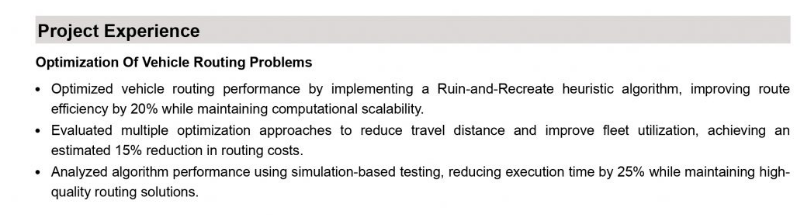
Resume Project Section Examples
1. Resume Projects for Freshers
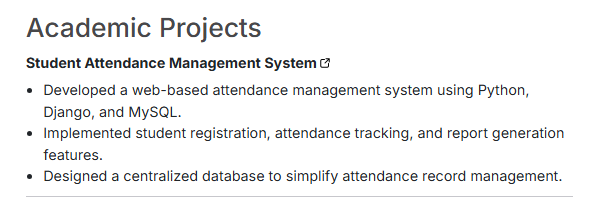
2. Resume Projects for Software Developers
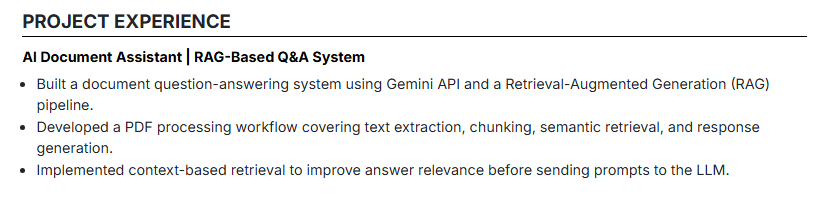
3. Resume Projects for Data Analysts
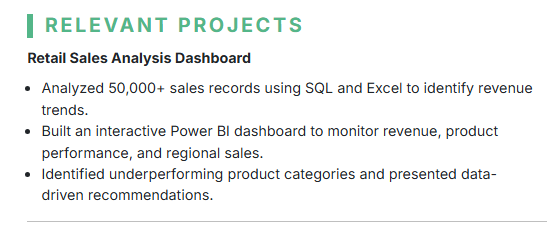
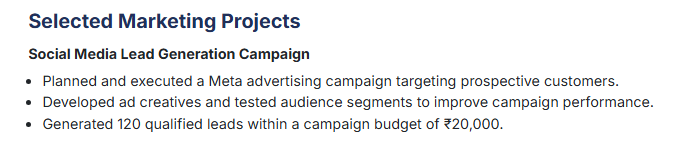
4. Resume Projects for Digital Marketing Professionals
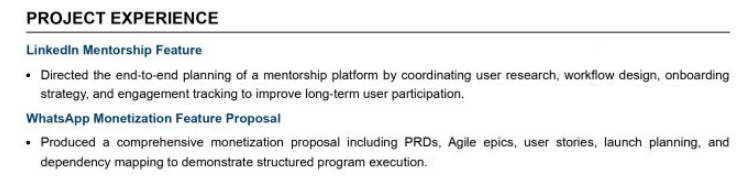
5. Resume Projects for Product Manager
6. Resume Projects for Business Intelligence

FAQs
1. How many projects should I include on my resume?
Most candidates should include 2-4 relevant projects. Focus on projects that best demonstrate your skills and are related to the job you are applying for.
2. Should I include projects if I already have work experience?
Yes, if the projects highlight important skills, achievements, or expertise that are not fully covered in your work experience section.
3. How do I write projects on a resume with no experience?
You can include academic, personal, internship, or freelance projects. Explain what the project was about, your role, the tools used, and the outcome.
4. Should I include personal projects on my resume?
Yes. Personal projects can show initiative, practical skills, and a willingness to learn, especially for freshers and career changers.
5. Should I include college projects on my resume?
Yes, especially if you are a student or recent graduate. Choose projects that demonstrate relevant skills and clearly explain your contribution.
6. How do I make my project section ATS-friendly?
Use a clear heading such as “Projects,” include relevant keywords naturally, and use simple, consistent formatting with bullet points.
7. Should I include project descriptions or only project titles?
Include a short description for each project. This helps recruiters understand your role, the skills you used, and what you achieved.
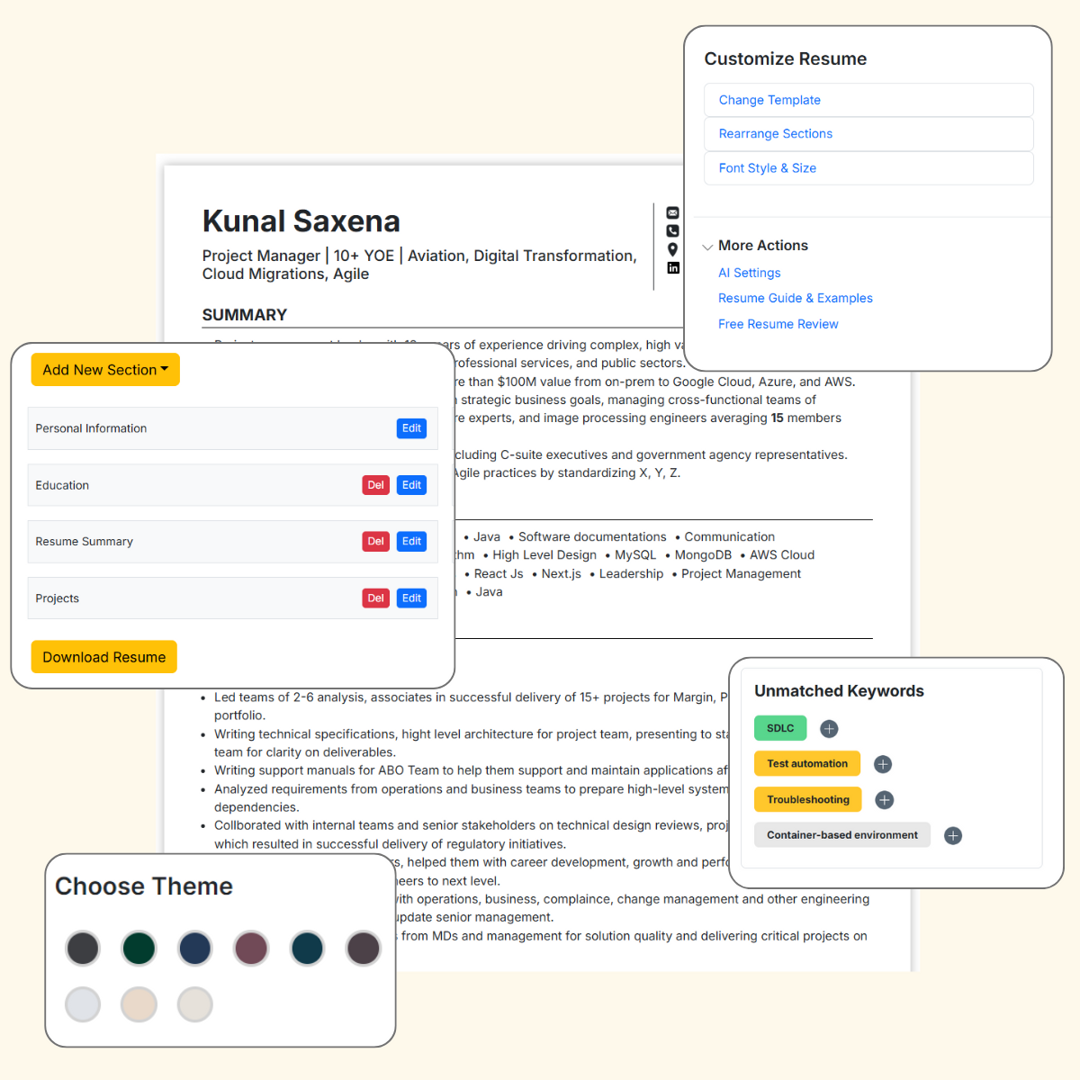
Author – Ayush Panthri
Connect on LinkedIn

Reviewer – Kunal Saxena
Kunal is a seasoned Technical Resume Writer with over 13 years of experience working with startups, mid-sized firms, and top global companies like Goldman Sachs and EY. He brings deep domain expertise across tech, education, insurance, e-commerce, and investment banking.
He has helped hundreds of professionals from top firms—including Apple, Meta, Google, Adobe, and Amazon — land interviews and advance their careers globally. His approach blends real-world hiring insight with high-impact resume strategy.
Kunal is an active member of Career Thought Leaders and the Resume Writing Academy, staying current with global resume trends and recruiter expectations.
Connect on LinkedIn
Amit got 2 Offers with our resume builder

My experience was truly outstanding, I got 3-5 interview calls and 2 job offers. The resume wasn't just focused on my current job - it captured my consulting, technical and leadership skills as well. Plus this was much more affordable
Data Engineer - Deloitte