Resume Personal Details Section Guide
 Ayush Panthri · 11 min read

The personal details section is one of the first things recruiters notice on your resume. It provides basic information about you and makes it easy for employers to get in touch with you. Details such as your phone number, email address, location, and LinkedIn profile help recruiters contact you and learn more about your professional background.
But many job seekers are unsure about what personal details they should include. Should you mention your date of birth, marital status, photograph, or full residential address? Adding too much personal information can make your resume look untidy, while leaving out important contact details may make it difficult for recruiters to reach you.
In this guide, you’ll learn what personal details to include in your resume, what information you can leave out, and how to write this section in a simple and professional way.
By end of this you”ll know
Personal details vs. contact details
Many candidates confuse between personal details and contact details. While they are related but they are not the same. You can understand this difference in the given below table and will help you to add the right information to your resume.
| Personal details | Contact details |
|---|---|
| Full name | Phone number |
| Date of birth | Professional email address |
| Age | City and state/country |
| Gender (if required) | LinkedIn profile URL |
| Nationality (if relevant) | Portfolio website |
| Marital status (if required) | GitHub profile URL |
| Languages known | Portfolio website |
| Work authorization or visa status (if relevant) | Professional website |
What Personal Details Should You Include in a Resume?
The personal details you include in your resume should depend on the job you are applying, the country where you are applying, and the employer’s requirements. In most cases, you only need to provide basic contact information so recruiters can reach you easily and learn more about your professional background.
Here are the important details you can include in your resume.
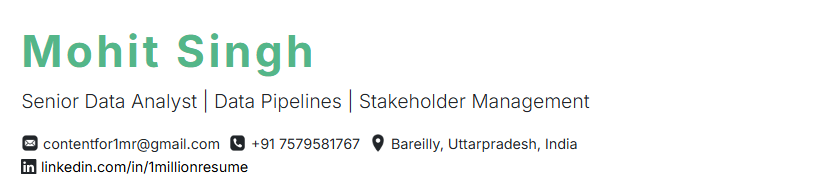
1. Full Name – Your full name should be clearly visible at the top of your resume so recruiters can easily identify you. Use the name you commonly use in professional settings and keep it consistent across your resume, LinkedIn profile, and job applications. You do not need to write “Name:” before your name. Simply adding your name at the top is enough.
Example: Mohit Singh
2. Phone Number – Include an active phone number that recruiters can use to contact you about interviews or job opportunities. Make sure you check your phone regularly and provide the correct country code when applying for jobs internationally. Always double-check your number before submitting your resume to avoid missing important calls.
Example: +91 98765 43210
3. Professional Email Address – Your email address should look professional and be easy to read. Recruiters often use email to share interview invitations, job updates, and other important information, so choose an address that you check regularly. Avoid using email addresses with funny nicknames, unnecessary numbers, or informal words. If your current email address is not suitable for job applications, consider creating a separate professional account.
Good examples:
- rahul.sharma@email.com
- rahul.kumar@email.com
- rsharma@email.com
4. Location – Mention your current city and state or your city and country, depending on where you are applying. This helps recruiters understand your location and whether you may be available for an office-based or hybrid role.
Example: Bengaluru, Karnataka, India
5. LinkedIn Profile – Adding your LinkedIn profile allows recruiters to learn more about your professional background, work experience, skills, certifications, and achievements. It can also help them understand your career interests beyond what you have included in your resume. Before adding your LinkedIn link, make sure your profile is updated and matches the information in your resume. You can also customize your LinkedIn URL to make it shorter and easier to read.
Example: linkedin.com/in/vishnukumar
6. Portfolio or GitHub Link – If your work can be displayed through projects or samples, consider including a portfolio or GitHub link in your resume. These links allow recruiters to see your skills in action instead of relying only on your written descriptions. Include only relevant links that showcase your abilities. Before sharing them, check that they work correctly and that the content is suitable for potential employers.
Examples:
- Portfolio: ankurgangwar.com
- GitHub: github.com/ankurgangwar
7. Languages (When Relevant) – Language skills can be useful when a job involves in communicating with international clients, working with people from different regions, teaching, or translating content. You can list the languages you speak and your proficiency level to help recruiters understand your communication abilities. Although languages can be useful information, it is generally better to include them in a separate Languages section rather than in your personal details section.
Example:
- English – Professional Proficiency
- Hindi – Native Proficiency
- German – Intermediate Proficiency

What Personal Information Should You Exclude from a Resume?
In the given below statement you can see which types of personal information you can generally avoid while including in your resume unless the employer, job, or application requirements specifically ask for them.
1. Date of Birth and Age – Your date of birth and age are generally not necessary on a resume. Recruiters usually focus on your qualifications, skills, and experience to determine whether you are suitable for a position. Including your age may also lead to unfair judgments during the hiring process. Instead of sharing these details, use the space to highlight your professional experience, relevant qualifications, and achievements.
2. Marital Status – You do not usually need to mention whether you are single, married, divorced, or have children on your resume. These details are personal and generally do not help recruiters understand your ability to perform the job. Including your marital status can take up space that could be used to highlight your professional strengths.
Avoid adding details such as, Marital Status: Married or Single.
3. Religion or Caste – Your religion and caste are generally not relevant to your professional qualifications or ability to perform a job. Including these details in a standard resume is usually unnecessary. Your resume should focus on your education, skills, work experience, and achievements rather than personal or social background.
4. Gender – In most cases, you do not need to mention your gender on your resume. Recruiters generally evaluate candidates based on their skills, qualifications, experience, and suitability for the role. Including your gender may provide personal information that is not necessary during the initial hiring process.
5. Full Residential Address – You do not usually need to include your complete home address on your resume. Details such as your house number, street name, apartment number, and postal code are often unnecessary during the initial hiring process. Sharing your full address may also expose more personal information than needed. In most cases, mentioning your city and state is enough to give recruiters an idea of your location.
For example, Instead of: House No. 25, Street Name, Apartment 4B, Bengaluru, Karnataka, 560001
Use: Bengaluru, Karnataka, India
6. Photograph (Unless Required or Appropriate) – Adding a photograph to your resume is not necessary for most job applications in many countries. Recruiters generally want to understand your qualifications, skills, and experience rather than your appearance. A photograph can also take up space that could be used for more relevant information. However, some countries, industries, or employers may expect or request one.
7. National Identification Numbers and Sensitive Documents – Your resume should not contain sensitive identification or financial details. Information such as your Aadhaar number, PAN number, passport number, bank account number, or driving license number is generally unnecessary during the initial hiring process. Including these details can expose you to privacy and security risks if your resume is shared with multiple people or stored in different systems.
8. Salary History – Your previous salary does not usually need to appear on your resume. A resume should highlight your professional experience, skills, and achievements rather than how much you earned in your previous job. Including salary details can distract recruiters from your qualifications and may affect how they approach compensation discussions.
How to Add Personal Details to Your Resume
If you know what personal details to include, the next step is to present your details clearly. You can follow given below simple tips to present your personal details professionally into your resume.
1. Place Your Details at the Top of Your Resume – Your name and contact information should appear at the top of your resume, where recruiters can find them easily. You can place your contact details just below your name or arrange them alongside your name and just below your professional headline. This section should make it easy for recruiters to identify you and understand how to contact you without searching through the entire document.
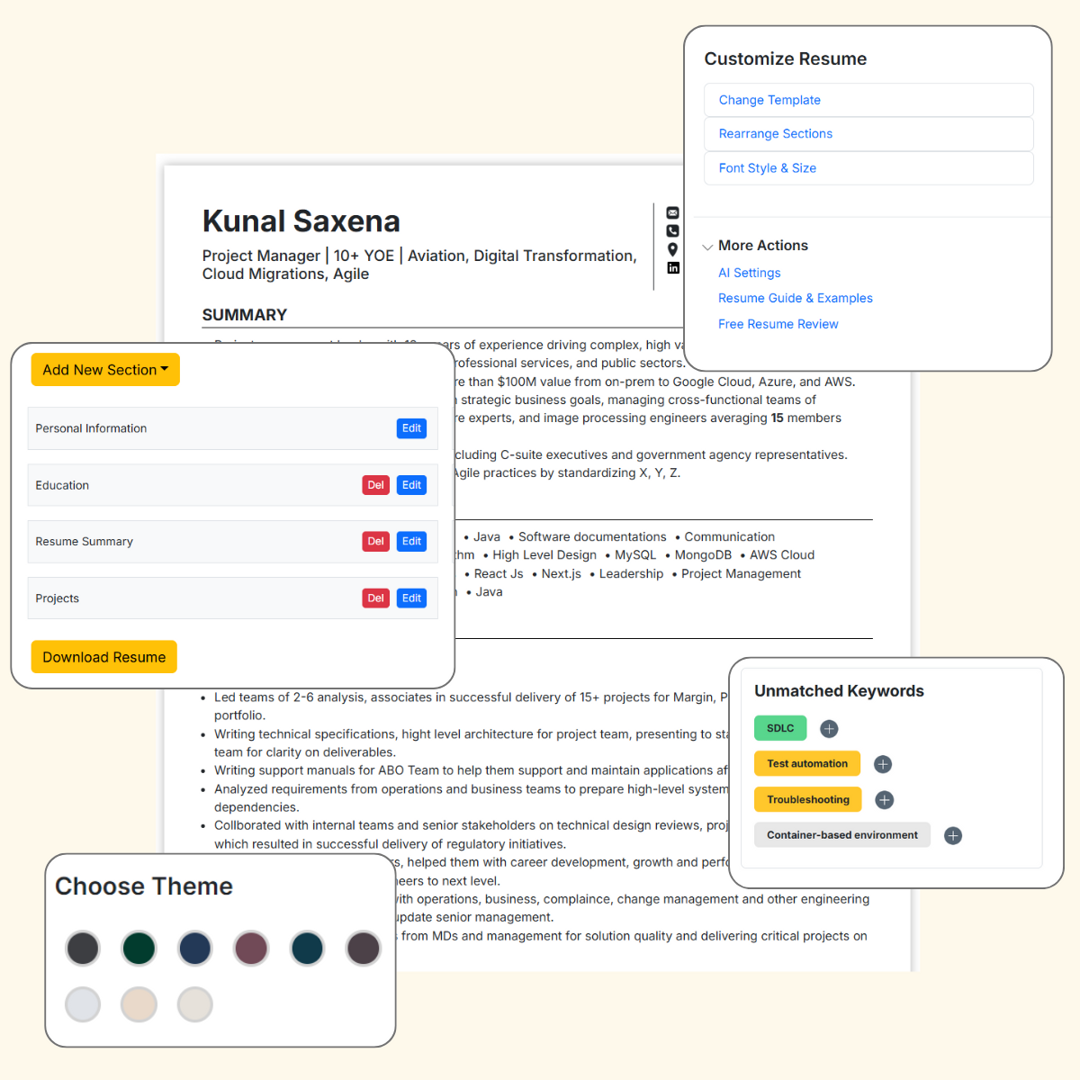
2. Keep the Separate Section – You can create separate section and place it at the last bottom of your resume. Use our AI Resume Builder tool and select add new section then click on other details and add personal information section in your resume. You do not need to write a paragraph explaining your personal background. A few well-organized lines are enough to share the information recruiters need.
3. Use a Simple and Readable Format – Your resume should be easy to read for both recruiters and applicant tracking systems (ATS). An ATS is software that employers use to collect, scan, and organize resumes during the hiring process. A complicated layout may make it difficult for some systems to identify your contact information correctly.
4. Add Professional and Working Links – If you include links to your LinkedIn profile, GitHub account, or online portfolio, make sure they are relevant to the job you are applying. These links can help recruiters learn more about your professional background, technical skills, and your previous work.
Resume Personal Details for Different Job Types
You do not need to include every personal detail in your resume. In the given below you can see clearly which personal details you should include in your resume for different job types.
1. Freshers – If you are a fresher, your resume should make it easy for recruiters to identify you and contact you. Include your full name, phone number, professional email address, and current location. Since you may not have much work experience, you can also include links to your LinkedIn profile, academic projects, or personal portfolio because sharing a relevant link can help recruiters understand your skills.

2. Software Engineers and IT Professionals – If you work in software development, cloud computing, data science, cybersecurity, or another IT field, consider including links that showcase your technical skills. Your LinkedIn profile can also help recruiters understand your work experience, technical expertise, and career progression.

3. Senior Professionals and Executives – If you are applying for a senior-level position, management role, or executive position, keep your personal details clear and professional. Your name, phone number, email address, location, and LinkedIn profile are generally sufficient. Your LinkedIn profile can provide additional information about your leadership experience, career achievements, and professional background.
4. Government and Public-Sector Job Applicants – If you are applying for a government or public-sector job, the personal information you need to provide may differ from that required for a private-sector position. Some government recruitment processes ask applicants to provide details such as their date of birth, category, nationality, or other information related to eligibility. However, these requirements changes depending on the country, recruiting agency, examination, and position.
5. International Job Applicants – If you are applying for jobs in another country, check the local resume or CV Protocol before deciding which personal details to include. For example, if an employer asks whether you are legally authorized to work in the destination country, provide an accurate answer through the application process. Before submitting your resume, review the employer’s instructions and make sure your contact information is suitable for international communication. Include your country code with your phone number when helpful, and use a professional email address that you check regularly.
FAQs
1. What personal details should I include in my resume?
For most applications, include your full name, phone number, professional email address, and city or location. Add your LinkedIn profile, portfolio, or GitHub link if it is relevant to the role.
2. Should I include my date of birth on my resume?
Usually, no. Your age and date of birth are generally unnecessary for standard job applications. Include them only when a legitimate application requirement or local convention calls for them.
3. Should I mention my marital status in my resume?
No, not for most standard applications. Marital status is generally unrelated to your professional qualifications and does not need to appear on your resume.
4. Is a full address necessary on a resume?
No. Your city and state or country are usually enough. Avoid sharing your complete residential address unless it is specifically required for a legitimate application process.
5. Should I add a photograph to my resume?
It depends on the country, industry, and employer. In many markets, photographs are unnecessary or discouraged. Follow the employer’s instructions and local application conventions.
6. How do I make my personal details section ATS-friendly?
Use readable text, a simple layout, and clear separators. Avoid relying on icons or images to communicate your phone number, email address, or other essential details. Keep important information out of complex headers and footers.
7. Should freshers include personal details such as hobbies and interests?
Freshers should prioritize contact information, education, skills, and relevant projects. Hobbies can be included in a separate section when they demonstrate useful skills or are relevant to the role, but they do not belong in the contact section.
Author – Ayush Panthri
Connect on LinkedIn

Reviewer – Kunal Saxena
Kunal is a seasoned Technical Resume Writer with over 13 years of experience working with startups, mid-sized firms, and top global companies like Goldman Sachs and EY. He brings deep domain expertise across tech, education, insurance, e-commerce, and investment banking.
He has helped hundreds of professionals from top firms—including Apple, Meta, Google, Adobe, and Amazon — land interviews and advance their careers globally. His approach blends real-world hiring insight with high-impact resume strategy.
Kunal is an active member of Career Thought Leaders and the Resume Writing Academy, staying current with global resume trends and recruiter expectations.
Connect on LinkedIn
Amit got 2 Offers with our resume builder

My experience was truly outstanding, I got 3-5 interview calls and 2 job offers. The resume wasn't just focused on my current job - it captured my consulting, technical and leadership skills as well. Plus this was much more affordable
Data Engineer - Deloitte