Resume Hobbies & Interests Section Guide
 Ayush Panthri · 9 min read

A resume should mainly focus on your skills, work experience, education, and achievements. But in some situations, hobbies and interests can also help recruiters learn more about you as a person. For example, playing team sports may highlight teamwork and discipline, while volunteer work can demonstrate community involvement and a willingness to help others. That’s why, hobbies should not be included simply to fill empty space on your resume.
The best hobbies and interests are those that add value to your application and support your professional profile. When chosen carefully, they can help showcase positive qualities, relevant skills, and personal interests that align with the role.
In this guide, you’ll learn when to include hobbies and interests on a resume, how to choose the right ones, where to place them, what to avoid, and how to present them in a professional way.
By end of this you”ll know
Special Cases: When Should You Include Hobbies and Interests?
Hobbies and interests are not a required section on every resume. In most cases, employers pay more attention to your skills, work experience, education, and achievements.But there are certain situations where including hobbies and interests can add value to your resume and help recruiters learn more about you.
1. When You Have Limited Work Experience
Students, freshers, and recent graduates often have little or no professional experience. In such cases, relevant hobbies and interests can provide additional information about your activities, interests, and transferable skills. The purpose is not to present hobbies as professional experience. But they help recruiters understand how you spend your time and what skills or qualities you may have developed through these activities.
Examples include: Playing team sports, Volunteering, Working on coding projects, Photography, Public speaking, Organizing college events.
2. When Your Hobby Is Relevant to the Job
A hobby can be worth including on your resume if it is related to the job you are applying for. For example, if you are applying for a content writing or marketing role, hobbies such as writing, blogging, or photography can be relevant if you genuinely enjoy and practice them. Similarly, if you are applying for a sports-related role, mentioning sports or fitness activities may be helpful. When a hobby supports the skills needed for the job, it can make your application stronger.
3. When Your Hobbies Demonstrate Transferable Skills
Some hobbies can show skills and qualities that are useful in the workplace. Only include hobbies that genuinely reflect your interests and experiences and add value to your resume.
For example:
- Team sports can demonstrate teamwork and collaboration.
- Volunteering can show responsibility and community involvement.
- Debate can highlight communication and public speaking skills.
- Event organization can demonstrate planning and coordination abilities.
- Blogging can showcase writing and content creation skills.
4. When You Want to Show Some Personality
A resume should mainly focus on your skills, experience, and qualifications. However, it can also help employers learn a little more about you as a person. For some jobs and company cultures, relevant hobbies and interests can show your personality and may even create conversation topics during interviews. But still, this section should remain a small part of your resume and should never distract from your qualifications.
Hobbies vs. Interests: What’s the Difference?
Hobbies and interests are often mentioned together on a resume, but they are slightly different. Understanding this difference can help you present this section more effectively on your resume.
What Are Hobbies? – Hobbies are activities that you regularly do in your free time. They involve active participation and are usually things you enjoy doing. In simple terms, a hobby is something you actively spend time in doing.
Some examples of hobbies include:
- Playing cricket
- Reading novels
- Photography
- Painting
- Cooking
- Running
- Playing chess
- Gardening
What Are Interests? – Interests are subjects, topics, or areas that you enjoy learning about, following, or exploring. Unlike hobbies, interests do not always involve a regular activity.
Some examples of interests include:
- Artificial Intelligence (AI)
- Technology
- Personal Finance
- Sustainability
- Entrepreneurship
- Behavioral Psychology
- Current Affairs
- Digital Marketing
How do you choose the right hobbies & interests and avoid the wrong ones?
Adding hobbies and interests to your resume is not simply about listing activities you enjoy. The goal is to include hobbies and interests that support your professional image and help employers learn something positive about you. The right hobbies can highlight valuable skills, demonstrate your personality, and even help you stand out from other candidates.
1. Choose Hobbies and Interests That Are Genuine
Always include hobbies and interests that you genuinely enjoy and participate in. Avoid adding activities simply because you think recruiters will find them impressive. For example, if you list writing, photography, chess, or volunteering on your resume, you should be comfortable discussing them during an interview. Being able to talk naturally about your hobbies shows authenticity and can help create a positive conversation during the interview.
2. Choose Relevant Hobbies When Possible
The most effective hobbies and interests are those that relate to the role, industry, or skills required for the job. For example, someone applying for a leadership role might include their Hobbies & Interests: Team sports, mentoring students, public speaking these activities can give recruiters additional insight into the candidate’s interests and strengths and supporting their professional profile.
3. Avoid Generic Hobbies
Some hobbies are very common and do not tell recruiters much about you. These activities are not necessarily bad, but they can be too broad and may not add much value to your resume.
Examples:
- Listening to music
- Watching movies
- Traveling
- Reading
- Browsing the internet
4. Avoid Controversial or Sensitive Interests
It is generally best to avoid hobbies or interests that could create unnecessary bias or distract attention from your qualifications. Your resume should focus on your ability to perform the job, not on topics that may lead recruiters away from evaluating your professional skills and experience. So do not add this type of Hobbies & Interests on your resume.
5. Do Not Exaggerate Your Interests
Be honest about your hobbies and interests. Avoid making casual activities sound more significant than they really are. For example, if you occasionally play cricket with friends on weekends, do not describe yourself as a competitive cricket player unless that is genuinely true. Recruiters value honesty, and inaccurate information can damage your credibility if discussed during an interview.
How and Where to List Hobbies and Interests on a Resume
If you want to list hobbies and interests on your resume, it is important to place them in the right location and present them in a clear, professional way. In most cases, hobbies and interests should appear near the end of your resume, after the sections that contain your most important professional information.
A resume structure looks like this: Contact Information → Resume Summary → Skills → Work Experience → Education → Certifications → Projects → Hobbies → Interests.
But, the exact order can changes depending on your career stage and experience level. For example, students and fresh graduates often place their Education and Projects sections higher on the resume because they may have limited work experience. Experienced professionals typically give more space to their work history, achievements, and professional accomplishments.
Use a Clear Section Heading – Choose a simple and professional heading for this section. Whichever heading you choose, keep the formatting consistent with the other section titles on your resume. Like given below:
- Hobbies & Interests
- Interests
- Activities & Interests
Keep the Section Short and Simple – Your hobbies and interests section should be brief and easy to scan. Recruiters usually spend only a limited amount of time reviewing each resume, so there is no need to include a long list of activities. A few relevant hobbies are usually enough.
Example: Hobbies & Interests: Cricket, photography, volunteering, reading business biographies
Be Specific When Possible – Specific hobbies provide more information than broad or generic descriptions because specific interests help recruiters better understand your interests and can make your resume more understandable.
Example: Instead of writing this → Reading, Sports, Travel.
You can write this → Reading business biographies, Cricket, Travel photography.
Avoid Long Explanations – In most cases, you do not need to explain why you enjoy a particular hobby or what skills it has helped you develop because a simpler approach is usually better, it keeps the section clean, professional, and easy to read.
Example: Cricket | Photography | Volunteering
Examples of Hobbies and Interests for a Resume
The best examples depend on your background and the role you are targeting.
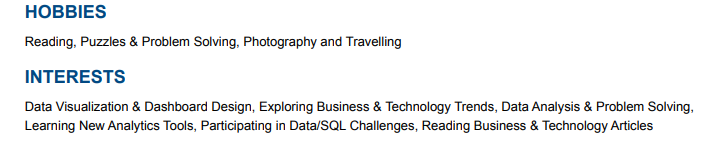
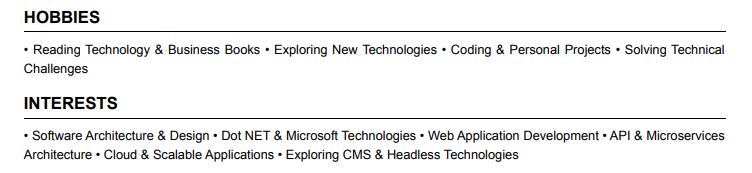
Example for Software Engineer
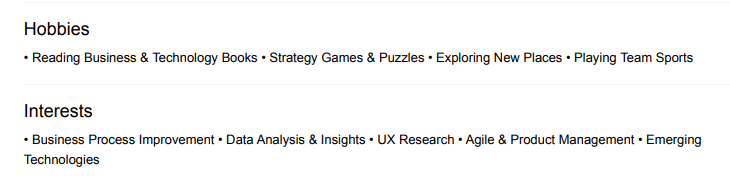
Example for Business Analyst
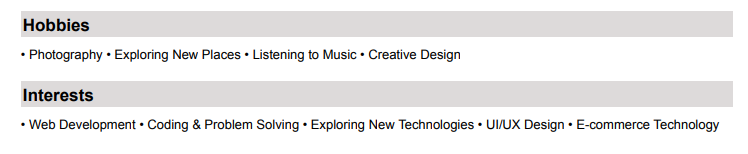
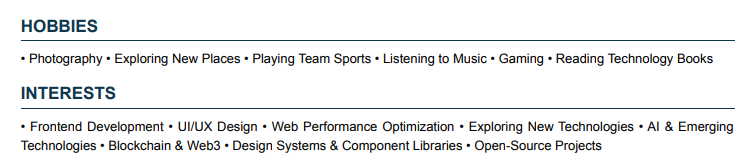
Example for Frontend Engineer
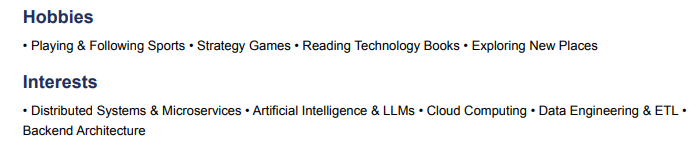
Example for Backend Engineer
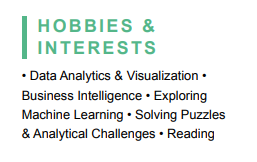
Example for Data Analyst
Example for Cybersecurity

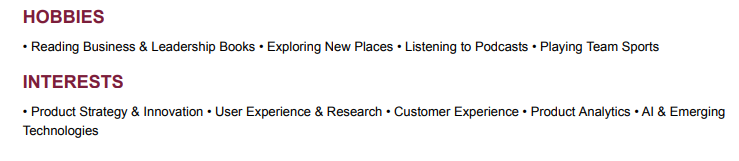
Example for Product Manager
Example for Sales Manager
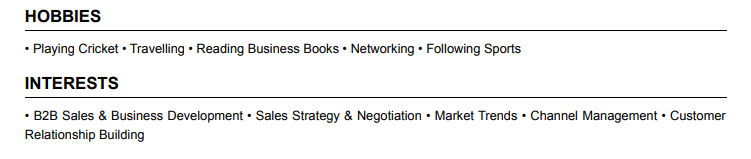
Example for English Teacher

Frequently Asked Questions (FAQ’s)
1. Should You Include Hobbies and Interests on a Resume?
Include hobbies and interests only when they add value to your resume or provide useful information about your background. They are often most helpful for students, freshers, and candidates with limited work experience.
2. Should Hobbies Be Relevant to the Job?
Hobbies do not have to be directly related to the job, but relevant hobbies can help highlight transferable skills and interests. Focus on activities that create a positive impression.
3. How Many Hobbies Should I Put on My Resume?
A short list of 3–5 hobbies or interests is usually enough. Keep the section concise and relevant.
4. Should Freshers Include Hobbies and Interests?
Yes, freshers can include hobbies and interests to add context to their profile. However, they should not replace important sections such as education, skills, projects, or internships.
5. Where Should Hobbies and Interests Go on a Resume?
Hobbies and interests are typically placed near the bottom of the resume after more important sections such as experience, education, and skills.
6. Should I Add Hobbies to an ATS-Friendly Resume?
Yes, if they add value to your application. However, ATS optimization should focus primarily on relevant skills, experience, education, and job-related keywords.
Author – Ayush Panthri
Connect on LinkedIn

Reviewer – Kunal Saxena
Kunal is a seasoned Technical Resume Writer with over 13 years of experience working with startups, mid-sized firms, and top global companies like Goldman Sachs and EY. He brings deep domain expertise across tech, education, insurance, e-commerce, and investment banking.
He has helped hundreds of professionals from top firms—including Apple, Meta, Google, Adobe, and Amazon — land interviews and advance their careers globally. His approach blends real-world hiring insight with high-impact resume strategy.
Kunal is an active member of Career Thought Leaders and the Resume Writing Academy, staying current with global resume trends and recruiter expectations.
Connect on LinkedIn
Amit got 2 Offers with our resume builder

My experience was truly outstanding, I got 3-5 interview calls and 2 job offers. The resume wasn't just focused on my current job - it captured my consulting, technical and leadership skills as well. Plus this was much more affordable
Data Engineer - Deloitte