Resume Education Section Guide
 Ayush Panthri · 8 min read

The education section is one of the important parts of a resume because it helps employers understand your academic background and qualifications. The amount of detail you can include in your education section depends on your career stage, the role you are targeting, and how relevant your education is to the position and its basic purpose is to help employers quickly verify whether your academic background meets the requirements of the role.
If you are a student or recent graduate, education can play a major role on your resume.If you have several years of professional experience, your work history will usually carry more weight, and your education section can be kept shorter.
In this guide, you’ll learn what information to include in your education section, where to place it on your resume, and how to present it in a clear, ATS-friendly format with examples.
By end of this you”ll know
What to Include in the Education Section
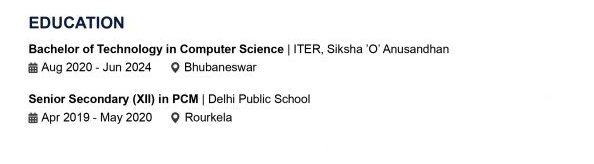
The education section should give employers a clear overview of your academic qualifications. You can include your degree, field of study, institution name, and graduation date. Depending on your experience level, you can also add details that strengthen your application.
1. Degree or Qualification – Start by listing your degree or qualification. Whenever possible, write the full degree name and include your major or field of study. Example: Diploma in Mechanical Engineering, Bachelor of Science in Computer Science, Master of Business Administration (MBA). Using the full degree name makes it easier for recruiters and ATS software to understand your qualifications.
2. Institution Name – Include the full name of your college, university, or educational institution. Example: University of Mumbai, Indian Institute of Technology Delhi.
3. Location – You can include the city and state or country of your institution. Example: Delhi India, Toronto Canada. This is especially useful if you studied outside your current location.
4. Graduation Date – Add your graduation year or month and year. If you are still studying, mention your expected graduation date. Example: Graduated: May 2025, Expected Graduation: May 2028. This can helps employers understand your current education status.
What you can also add
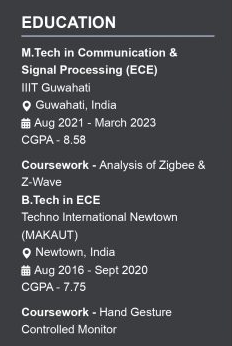
GPA or CGPA – Including your GPA or CGPA is optional. It is most useful for students and recent graduates, especially if the score is strong or requested by the employer. Example: CGPA: 8.6/10, GPA: 3.8/4.0.
Relevant Coursework – If you have limited work experience, relevant coursework can help demonstrate your knowledge and skills. Example: Analysis of Zigbee & Z-Wave, Hand Gesture Controlled Monitor. Only include courses that are relevant to the job you are applying.
Where to Put the Education Section on a Resume
Education section placement on your resume depends on your experience level, career stage, and how important your education is for the role you are applying and the main goal of resume is to highlight your most relevant qualifications first to the Recruiters.
For Students and Recent Graduates
If you are a student or have recently completed your studies, your education is likely one of your strongest qualifications. Since you may not have much professional experience yet, it makes sense to place the education section higher on your resume. A common structure is: Contact Information → Career Objective → Skills → Education → Experience.
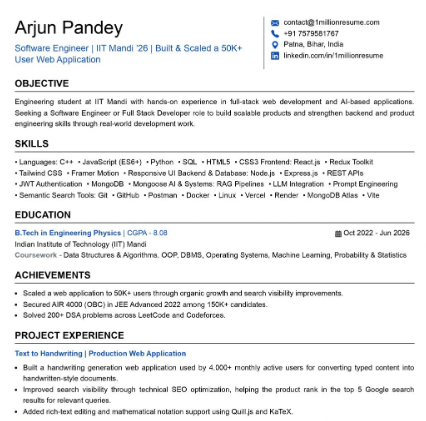
This above fresher resume format allows employers to quickly see your degree, field of study, academic achievements, relevant coursework, and certifications. When your work experience is limited, your educational background can help demonstrate your knowledge and potential for the role.
Situations Where Education Should Be Placed Higher
- You are currently a student or recently graduated.
- You are applying for an academic, teaching, or research position.
- Your educational background is highly relevant to the role.
- You have limited work experience.
- Your academic achievements are stronger than your professional experience.
For Experienced Professionals
If you have several years of relevant work experience, your professional experience are usually more important to employers than your educational background. In this case, the education section should typically appear below after your work experience. A common Structure is: Contact Information → Summary → Skills → Experience → Education.
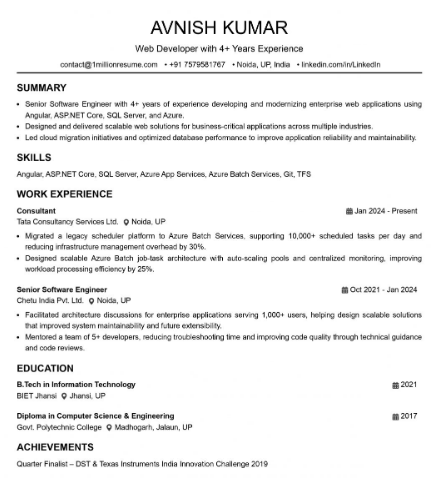
This above experienced professional resume format helps recruiters see your latest jobs, key responsibilities, achievements, and career progress first. If you have several years of professional experience your Education section generally moves below down the Work Experience section.
Resume Education Section Examples
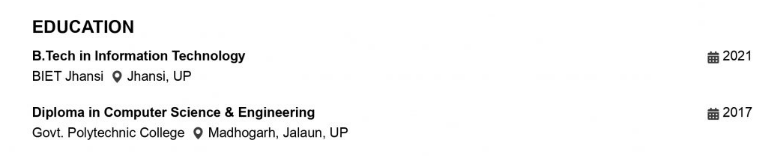
Example 1: Fresher Education Section

Example 2: Experienced Professional Education Section
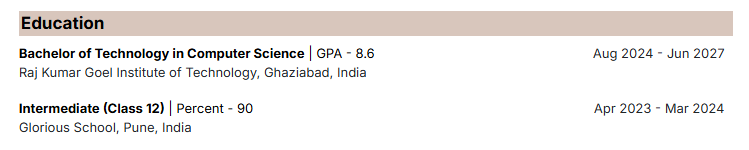
Example 3: Current Student Education Section
Example 4: Multiple Degrees Education Section

Example 5: Education With Honors
How to Tailor the Education Section to Your Career Stage
The amount of education details you can include in your resume should change as your career grows. Focus on adding the education details that are most relevant to your current career stage and the job you are applying.
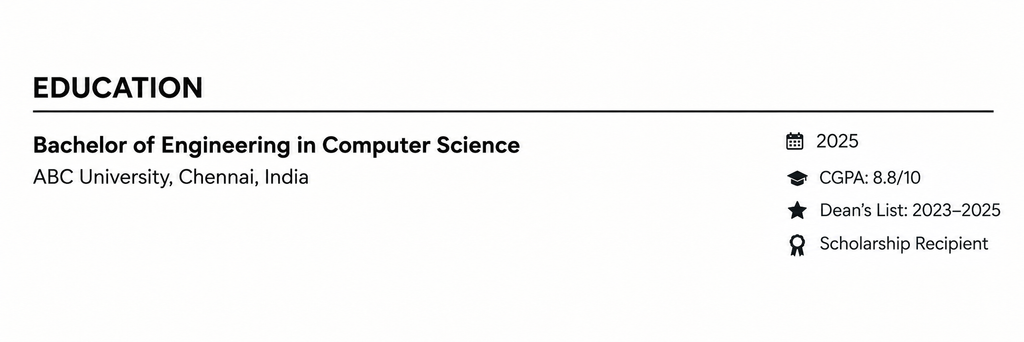
1. Students – If you are still studying, your Education section may be one of the strongest parts of your resume. Since you may have limited work experience, it can help employers understand your knowledge, skills, and potential. You can include: Degree or qualification, College or university name, Location, Expected graduation date, GPA/CGPA (if it is strong), Relevant coursework and Honors and awards.
Example:
| Bachelor of Engineering in Computer Science A.K.T.U University, Chennai, India | 2025 CGPA: 8.8/10 Coursework: Data Structure & Algorithms, OOP, DBMS, Operating Systems, Machine Learning. Dean’s List: 2023–2025 Scholarship Recipient |
2. Recent Graduates / Fresher – As a recent graduate, you can still include some educational details, but focus on information that is relevant to the job. You do not need to list every subject or academic activity. Instead, highlight the coursework, projects, or achievements that support your career goals.
Example:
| B.Tech in Information Technology M.J.P.R.U University | 2026 CGPA: 8.5/10 Relevant Coursework: Data Structures, Java, Database Management Systems, Computer Networks. |
3. Mid-Career Professionals – Once you have gained a few years of professional experience, your work history becomes more important than your academic background. At this stage you can keep your Education section simple and concise. Your resume should focus more on your professional accomplishments, skills, and career growth.
Example:
| MBA, Finance L.P.U University | 2019 – 2021 B.Com, Accounting T.M.K.U University | 2016 – 2019 |
4. Senior Professionals – For senior-level professionals, education usually serves as a supporting qualification rather than the main highlight of the resume and for Executive level professional with more than 20+ years of experience, including the education section is not always necessary, as recruiters are generally more interested in their recent work experience, achievements, and career impact.
How to Handle an Incomplete Degree, No Degree, or Unrelated Major
Not everyone follows the same educational path, and that is completely normal. Whether you didn’t finish a degree, are still studying, don’t have a degree, or studied a different subject than your target job, the key is to present your education honestly and clearly.
Incomplete Degree – If you attended a college or university but did not finish your degree, you can still include that education on your resume. Mention the school name, the years you attended, and any relevant coursework or credits completed. Be honest and do not list the degree as completed if you did not earn it. Employers appreciate honesty, and providing accurate information helps avoid issues during the hiring process.
Example:
ABC University, Delhi, India
Completed coursework toward Bachelor of Commerce
2019 – 2022
Degree in Progress – If you are currently studying, make it clear that your degree is still in progress. You can also include relevant coursework, academic projects, or achievements if they support your application.
Example:
Bachelor of Computer Applications
XYZ University, Pune, India
Expected Graduation: 2027
No Degree – Not having a college degree does not mean your Education section should be empty. You can highlight other forms of learning and professional development, such as: Continuing education programs, Certifications, Professional training programs, Bootcamps, Online courses, Apprenticeships because recruiters value your practical skills, relevant experience, and industry certifications. Focus on demonstrating what you know and what you can do. If a job requires a degree that you do not have, do not claim one. Instead, strengthen other parts of your resume, such as your skills, work experience, projects, and certifications.
Unrelated Degree – Having a degree in a different field does not mean you should remove it from your resume. For example, if you have a Bachelor of Arts in English but are applying for a software engineering role, the degree can still be included in your Education section. Focus more on the skills and experience that match the job. Such as: Relevant work experience, Technical projects, Certifications, Skills and Professional training.
Frequently Asked Questions (FAQ)
1. Should You Include Your GPA on a Resume?
Include your GPA only if it strengthens your application, especially if you are a student or recent graduate. Always mention the grading scale (for example, GPA: 3.8/4.0 or CGPA: 8.7/10).
2. Can you use AI to write the Education section?
Yes. AI can help format and organize your education details, but you should always review the output to ensure all information is accurate and unchanged.
3. How does ATS read the Education section?
ATS scans education-related details such as degree names, fields of study, institutions, certifications, and graduation dates. Using clear formatting and standard terminology helps ATS identify your qualifications correctly.
4. Can you include certifications and training in the Education section?
Yes, but it depends on your resume. If you have multiple important certifications, create a separate Certifications section. For one or two minor credentials, including them under Education may be appropriate.
5. Should you include school education on your resume?
Include school education when it is relevant to your career stage or qualifications. For most experienced professionals, higher education is usually more important than school-level details.
Author – Ayush Panthri
Connect on LinkedIn

Reviewer – Kunal Saxena
Kunal is a seasoned Technical Resume Writer with over 13 years of experience working with startups, mid-sized firms, and top global companies like Goldman Sachs and EY. He brings deep domain expertise across tech, education, insurance, e-commerce, and investment banking.
He has helped hundreds of professionals from top firms—including Apple, Meta, Google, Adobe, and Amazon — land interviews and advance their careers globally. His approach blends real-world hiring insight with high-impact resume strategy.
Kunal is an active member of Career Thought Leaders and the Resume Writing Academy, staying current with global resume trends and recruiter expectations.
Connect on LinkedIn
Amit got 2 Offers with our resume builder

My experience was truly outstanding, I got 3-5 interview calls and 2 job offers. The resume wasn't just focused on my current job - it captured my consulting, technical and leadership skills as well. Plus this was much more affordable
Data Engineer - Deloitte