Resume Certification Section Guide
 Ayush Panthri · 8 min read

Certification section in a resume helps employers understand your professional qualifications, specialized knowledge, skills in a specific area and commitment to continuous learning. The certifications you include should be relevant to your target role and can help demonstrate skills that may not be fully reflected in your education or work experience.
Certifications can be especially valuable when they are required or preferred for a position. They may also help recruiters quickly identify important qualifications and improve the visibility of relevant keywords in Applicant Tracking Systems (ATS).
In this guide, you’ll learn what certifications are, why they are important, how to choose the right certifications and how to list them in a clear, ATS-friendly format with examples.
By end of this you”ll know
How to Write Certifications on a Resume
Once you decide which certifications to include, the next step is listing them in a clear and professional format. Your certifications should be easy for recruiters to read and easy for Applicant Tracking Systems (ATS) to understand.
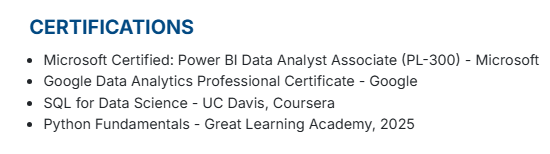
A simple format is: Certification Name | Issuing Organization | Date Earned | Expiration Date (if applicable)
For example: Project Management Professional (PMP) | Project Management Institute | March 2025
1. Use the Full Certification Name – Always use the official name of the certification whenever possible because the full certification name provides more context and can help recruiters and ATS software identify the qualification more easily.
Example: Project Management Professional (PMP)
2. Include the Issuing Organization – Add the name of the organization that awarded you the certification because it helps employers verify the credential and understand its source.
Example: AWS Certified Solutions Architect – Associate
Issued By: Amazon Web Services
3. Add the Date Earned – Include the month and year when you earned the certification. This shows how recent the certification is and helps recruiters understand the timeline of your qualifications.
Example: Issued: March 2026
4. Include the Expiration Date – Some certifications must be renewed after a certain period. If your certification has an expiration date, include it on your resume because it helps employers know that the certification is still valid or not.
Example: Issued: March 2025 | Expires: March 2028
5. List In-Progress Certifications Correctly – If you are currently preparing for a certification, you can still include it on your resume. Clearly mention that it is in progress and provide the expected completion date.
Example: Amazon Web Services | Expected Completion: December 2026
6. Add Related Skills When Relevant – In some cases, you can mention a few skills gained through the certification. It can be useful for freshers, career changers, or professionals learning a new area. Including relevant skills can help employers better understand the knowledge you gained from the certification.
Example: Google Data Analytics Professional Certificate | Completed February 2026
Skills: SQL, Data Analysis, Spreadsheets, Data Visualization
How to Choose the Right Certifications for Your Resume
Choosing the right certification is important part because you do not need to include every certification you have completed. Instead you can focus on certifications that are relevant to the job you are applying and which can help you to demonstrate your skills and qualifications.
1. Match Certifications to the Job Description – Before adding certifications to your resume, carefully read the job description. If the employer specifically asks for a certification that you hold, make sure it is clearly visible on your resume. This helps recruiters quickly see that you meet an important requirement for the role. Look for certifications mentioned under sections such as:
- Required Qualifications
- Preferred Qualifications
- Technical Skills
- Professional Certifications
- Additional Requirements
2. Choose Certifications Relevant to Your Target Role – Choose certifications that directly support the position you are applying for example, if you are applying for a Cloud Engineer role, a certification such as AWS Certified Solutions Architect – Associate is highly relevant because it demonstrates cloud computing knowledge and skills. If you have the certifications that are unrelated to the role, may add little value to your application. No matter the industry, the most useful certifications are those that show employers you have the skills needed for the job.
3. Consider Your Career Stage – The certifications you choose may depend on where you are in your career. For freshers and career changers, certifications can help demonstrate knowledge and commitment to a field when professional experience is limited. For experienced professionals, certifications are most valuable when they strengthen and support existing work experience.
For example:
Fresher
- Google Data Analytics Certificate
- Skills: SQL, Data Analysis, Data Visualization
Experienced Data Analyst
4+ years of experience analyzing business data and improving reporting processes
Google Data Analytics Certificate
4. Prioritize Recent and Active Certifications – If you have completed several certifications, focus on the most recent and relevant ones. If your certifications that have expiration or renewal requirements, make sure the information on your resume is accurate and up to date. Current certifications can show employers that your knowledge and skills are still relevant.
5. Remove Irrelevant Certifications – Every certification on your resume should have a purpose. A short list of relevant certifications is usually more effective than a long list of unrelated credentials. Keeping your certification section focused makes it easier for recruiters to identify the qualifications that matter most for the role.
Resume Certification Examples
1. Software Engineer Resume
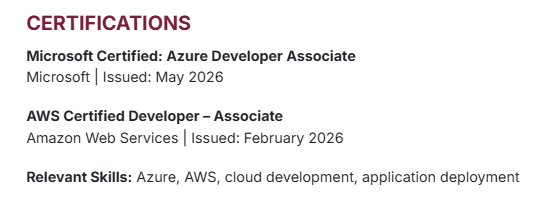
2. Project Manager Resume
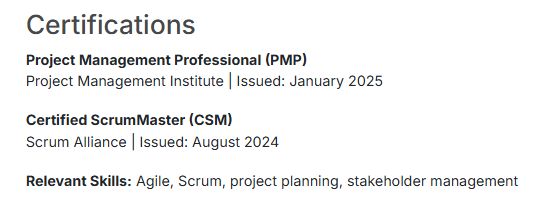
3. Data Analyst Resume
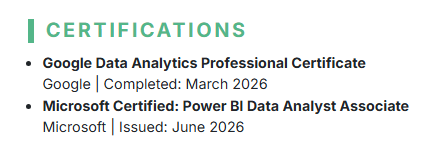
4. Backend Engineer Resume
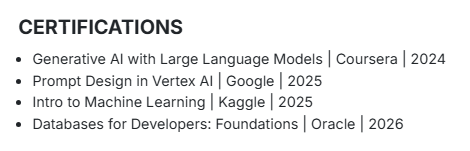
5. Cybersecurity Resume
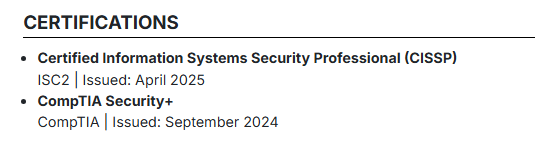
6. Program Manger Resume
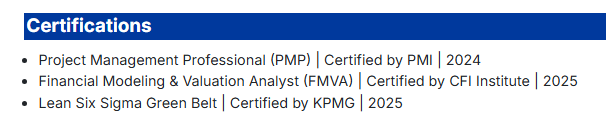
7. Business Intelligence Resume
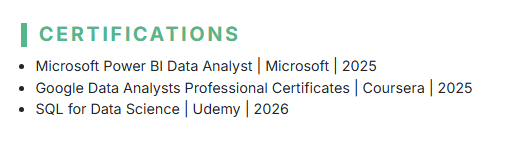
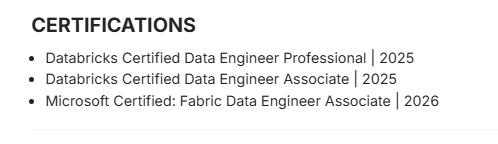
8. Data Engineer Resume
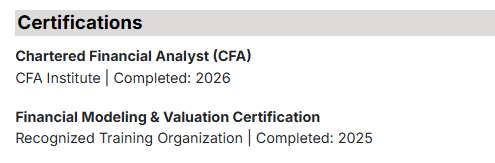
9. Finance Resume
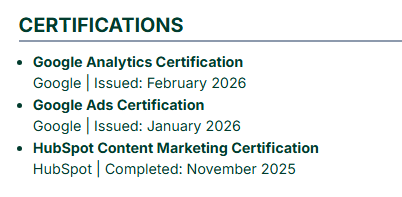
10. Digital Marketing Resume
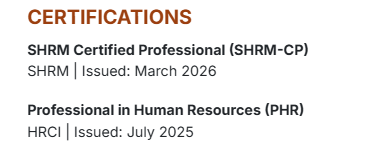
11. HR Resume
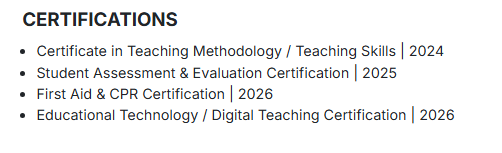
12. Teacher Resume
Common Mistakes to Avoid When Listing Certifications
If you adding certifications to your resume it can strengthen your application, but simply listing them is not enough. How you present your certifications matters just as much as the certifications themselves. Here are some common mistakes job seekers make and how to avoid them.
1. Listing Every Certification You Have – You do not need to include every certification you have ever completed. A long list of unrelated certifications can make your resume look unfocused and make it harder for recruiters to identify your most relevant qualifications.
Better approach: Include certifications that are relevant to the job you are applying for and support your target role.
2. Using Only Acronyms – Some candidates list certifications using only abbreviations, such as: PMP, CISSP, CCNA, CPA. Not every recruiter may be familiar with these acronyms, and ATS software may not always recognize them correctly.
Better approach: Write the full certification name first and include the acronym in parentheses. This makes your certification easier for both recruiters and ATS systems to understand.
Example: Project Management Professional (PMP)
3. Not Mentioning the Issuing Organization – A certification name alone does not provide complete information. The issuing organization helps recruiters understand who awarded the credential and adds credibility to your certification.
Example: AWS Certified Solutions Architect – Associate | Amazon Web Services
4. Keyword Stuffing – Some candidates repeatedly mention certification names throughout their resumes to improve ATS matching. This can make the resume look unnatural and difficult to read.
Better approach: Use certification-related keywords naturally where they are relevant, such as in your: Certifications section, Skills section, Professional summary, Work experience, Projects section.
5. Claiming a Certification You Have Not Yet Earned – Avoid listing a certification as completed if you are still preparing for the exam. Instead, clearly mention that it is in progress because being honest about your certification status helps maintain your credibility.
Example:
AWS Certified Solutions Architect – Associate | In Progress
Expected Completion: December 2026
6. Adding Low-Value or Irrelevant Certifications – Do not add certifications simply to fill space on your resume because the recruiters are usually more interested in certifications that are relevant to the position and issued by recognized organizations. Focus on certifications that demonstrate valuable skills and support your career goals.
7. Listing Expired Certifications as Active – Do not present an expired certification as if it is still valid. If a certification is no longer active and is not relevant to the role, consider removing it from your resume. If it is still professionally relevant, clearly indicate its current status according to the certification provider’s guidelines you can include it.
FAQs
1. When should I include certifications on my resume?
Include certifications when they are relevant to the job, requested by the employer, required for the profession, or help demonstrate valuable skills. Certifications can also strengthen the profile of freshers and career changers who have limited work experience.
2. When should I leave a certification off my resume?
Avoid listing certifications that are unrelated to the target role, outdated, or do not add meaningful value. Focus on certifications that support your career goals and job requirements.
3. Where should I put certifications on a resume?
The most common approach is to create a dedicated Certifications section. However, highly relevant certifications can also be highlighted in your resume headline, summary, education section, or alongside related work experience.
4. How many certifications should I list on my resume?
There is no fixed number. Include the certifications that are most relevant to the position you are applying for. Quality and relevance are usually more important than quantity.
5. Should certifications be listed in the Skills section?
No. Certifications and skills serve different purposes. Skills describe your abilities, while certifications verify your knowledge or expertise through a recognized credential.
6. How can I make my certification section ATS-friendly?
Use a clear heading such as “Certifications,” write the full certification name, match relevant job description keywords when appropriate, avoid images or graphics, and use a consistent format for every certification entry.
Author – Ayush Panthri
Connect on LinkedIn

Reviewer – Kunal Saxena
Kunal is a seasoned Technical Resume Writer with over 13 years of experience working with startups, mid-sized firms, and top global companies like Goldman Sachs and EY. He brings deep domain expertise across tech, education, insurance, e-commerce, and investment banking.
He has helped hundreds of professionals from top firms—including Apple, Meta, Google, Adobe, and Amazon — land interviews and advance their careers globally. His approach blends real-world hiring insight with high-impact resume strategy.
Kunal is an active member of Career Thought Leaders and the Resume Writing Academy, staying current with global resume trends and recruiter expectations.
Connect on LinkedIn
Amit got 2 Offers with our resume builder

My experience was truly outstanding, I got 3-5 interview calls and 2 job offers. The resume wasn't just focused on my current job - it captured my consulting, technical and leadership skills as well. Plus this was much more affordable
Data Engineer - Deloitte