Resume Achievements Section Guide
 Ayush Panthri · 8 min read

The achievements section is an important part of a resume because it helps recruiters understand the results and impact of your work. While work experience explains your responsibilities, achievements show how you contributed to a team, project, or organization through measurable outcomes such as revenue growth, cost savings, process improvements, efficiency gains, successful project delivery, or customer growth. Strong achievements can make your resume more relevant, credible, and competitive by demonstrating the value you can bring to a potential employer.
In this guide, you’ll learn what achievements to include on your resume, how to write them effectively, where to place them, and how to present them with clear examples for different roles and industries.
By end of this you”ll know
Types of Achievements to Include on a Resume
The best achievements are those that show the impact of your work, skills, efforts, or contributions to the employers. Below are some of the most common types of achievements you can include on a resume.
1. Work Achievements – Work achievements highlight the results you delivered in your professional roles. These achievements help employers understand the value you brought to your previous organizations.
Example:
- Increased sales by 25% within one year.
- Improved operational efficiency by 20%.
- Managed a project worth ₹2 crore and delivered it within budget.
2. Revenue and Sales Achievements – If you work in sales, business development, account management, or revenue-focused roles, include achievements that show business growth and financial impact.
Example:
- Increased annual revenue by 28% through new client acquisition.
- Exceeded quarterly sales targets by 18%.
- Generated ₹50 lakh in new business within 12 months.
3. Cost-Saving Achievements – Cost-saving achievements demonstrate your ability to reduce expenses and improve resource utilization. These are particularly valuable in finance, operations, procurement, engineering, and management roles.
Example:
- Reduced annual operating costs by ₹15 lakh through vendor renegotiation.
- Reduced cloud infrastructure costs by 22% through resource optimization.
4. Project Achievements – Project achievements highlight successful projects you delivered, led, or contributed to. They are useful for project managers, product managers, engineers, consultants, and many other professionals.
Example:
- Delivered a software migration project two months ahead of schedule.
- Led a cross-functional team of 12 members to launch a new product.
5. Leadership Achievements – Leadership achievements demonstrate your ability to guide teams, manage people, mentor colleagues, or lead important initiatives.
Example:
- Led a team of 15 professionals across three locations.
- Mentored 10 junior employees, improving team productivity by 20%.
6. Technical Achievements – Technical achievements are especially valuable for software engineers, developers, cloud engineers, DevOps professionals, data professionals, and IT specialists. They show how you improved systems, performance, security, quality, or automation.
Example:
- Reduced application response time by 40% through database optimization.
- Reduced production incidents by 25% through improved monitoring and deployment processes.
7. Awards and Recognition – Awards and recognition show that your work, performance, or contributions were acknowledged by your employer, institution, or industry. Keep in mind that awards do not always need to be included in the Achievements section. If you have multiple important awards, you can create a separate Awards & Honors section on your resume.
Example:
- Received the “Employee of the Year” award for outstanding performance.
- Recognized as a “Top Performer” for exceeding annual sales targets by 20%.
Where to List Achievements on a Resume
There is no single rule about where achievements should be placed on a resume. Below are the most common places where you can include achievements on your resume.
1. In Work Experience Section – The work experience section is the best place to showcase achievements. Adding achievements under each job helps employers understand the impact you made in that role rather than just the tasks you performed. In the given below example you can see clearly, the achievements are directly connected to the candidate’s responsibilities, making them more meaningful and easier for recruiters to understand.
Example: Digital Marketing Manager | ABC Company | 2022 – Present
- Managed SEO and content strategy across multiple product categories.
- Improved conversion rate by 18% through landing-page optimization.
2. In a Separate Achievements Section – If you have many important accomplishments that are not related to one specific role, you can create a separate Achievements or Key Achievements section. You can keep this section focused on your most impressive accomplishments and avoid repeating achievements that are already listed in your work experience section.
Example: KEY ACHIEVEMENTS
- Received Employee of the Year recognition for outstanding performance.
- Increased annual revenue by 28% through a new sales strategy.
3. Resume Summary – Including one strong achievement in your resume summary can quickly show employers the value you can bring but you can avoid turning this section into a long list of accomplishments.
Example: Resume Summary
- Finance Manager with 10+ years of experience in budgeting, forecasting, and financial planning.
- Proven track record of reducing operating costs by 18% through effective financial management and cost optimization.
4. Awards and Honors Section – If you have received multiple awards / more than 3, scholarships, or formal recognitions, you can consider creating a separate Awards & Honors section in your resume. This makes you important achievements easy for recruiters to find.
Example: Awards & Honors Section
- Employee of the Year – 2025
- Best Project Award – 2024
- Sales Excellence Award – 2023
5. Projects Section – If you have achievements related to your specific projects you can include it within the project description because including project achievements can helps employers understand the results and impact of your work.
Example: Customer Analytics Dashboard
- Built a Power BI dashboard to track customer behavior.
- Helped identify high-value customer segments for targeted marketing campaigns.
How to Write Achievements on a Resume
Strong achievements show the impact of your work, not just the tasks you performed. One of the easiest ways to write effective achievement statements is by using the CAR Formula:
Challenge → What problem, goal, or opportunity did you face?
Action → What steps did you take?
Result → What was the outcome of your efforts?
Whenever possible you can include numbers, percentages, revenue figures, time savings, cost reductions, or other measurable results because quantifiable achievements help recruiters understand the value you delivered and make your resume more credible.
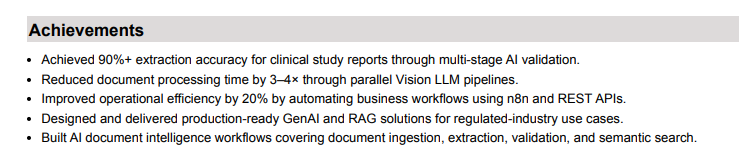
A strong achievement statement typically follows this structure: Action Verb + What You Did + Result. After applying this approach, your achievements may look like this on your resume:
Resume Achievements Examples by Industry
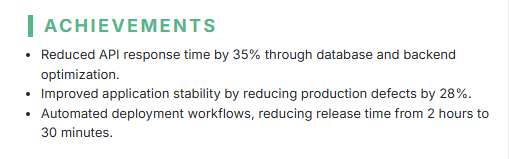
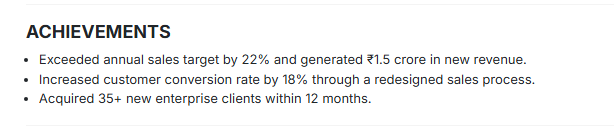
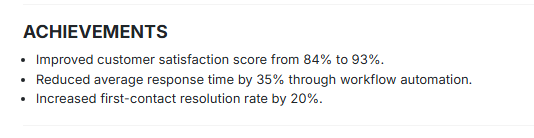
Here are the some examples of achievements given below across the different industries and roles.
1. Software Engineering
2. Data & Analytics

3. Finance & FP&A

4. Sales
5. Marketing

6. Human Resources

7. Project & Program Management

8. Customer Service
Tips to Make Your Resume Achievements Stand Out
A strong achievement should clearly show the value you created in your previous roles. The following tips can help you write achievement statements that are easier for recruiters to understand and more relevant to the jobs you are applying for.
1. Use Numbers Whenever Possible – Numbers make achievements more specific and credible. They help recruiters quickly understand the impact of your work. For example, saying that you increased team productivity by 20% is more informative than simply saying you improved team performance.
2. Focus on Results, Not Just Tasks – Achievements should explain the outcome of your work, not just your responsibilities. A good question to ask yourself is: What changed because of my work? The answer can often help you turn a job duty into a meaningful achievement.
3. Start With Strong Action Verbs – Begin your achievement statements with action-oriented words such as Increased, Reduced, Improved, Led, Automated, Optimized, or Delivered. These words make your contributions sound clearer and more impactful.
4. Be Honest and Accurate – Only include results and numbers that you can confidently support. Accurate achievements build credibility, while unsupported claims can create problems during interviews or background checks.
5. Avoid Repeating the Same Achievement – If an achievement is already included in your Work Experience section, you usually do not need to repeat it in a separate Achievements section. Use that space to highlight additional accomplishments that strengthen your resume.
6. Keep Achievement Statements Short and Easy to Read – Recruiters often scan resumes quickly. Use concise bullet points that clearly explain what you did, the impact of your work, and the result you achieved.
7. Tailor Achievements to the Job Description – Before submitting your resume, review the job description and prioritize achievements that match the skills and responsibilities the employer is looking for. This can make your resume more relevant and targeted to the role.
Frequent ask Questions (FAQs)
Can I include awards in the Achievements section?
Yes. Awards and recognition can be listed as achievements, especially when they highlight strong performance or professional accomplishments. If you have several important awards, consider creating a separate Awards & Honors section.
Can freshers include achievements on a resume?
Yes. Freshers can include academic achievements, project accomplishments, competition results, leadership roles, volunteering, sports, or extracurricular achievements.
What is the difference between responsibilities and achievements?
Responsibilities describe your job duties, while achievements highlight the results or impact of your work.
Should achievements include numbers?
Whenever possible, yes. Metrics such as percentages, revenue, cost savings, time saved, or team size can make achievements more specific and credible.
Can AI help write resume achievements?
Yes. AI can help convert responsibilities into achievement-focused statements, but you should always verify the information and ensure it accurately reflects your experience.
Should awards and achievements be listed separately?
If you have only a few awards, they can be included under Achievements. If you have several notable awards, a separate Awards & Honors section may be a better option.
Author – Ayush Panthri
Connect on LinkedIn

Reviewer – Kunal Saxena
Kunal is a seasoned Technical Resume Writer with over 13 years of experience working with startups, mid-sized firms, and top global companies like Goldman Sachs and EY. He brings deep domain expertise across tech, education, insurance, e-commerce, and investment banking.
He has helped hundreds of professionals from top firms—including Apple, Meta, Google, Adobe, and Amazon — land interviews and advance their careers globally. His approach blends real-world hiring insight with high-impact resume strategy.
Kunal is an active member of Career Thought Leaders and the Resume Writing Academy, staying current with global resume trends and recruiter expectations.
Connect on LinkedIn
Amit got 2 Offers with our resume builder

My experience was truly outstanding, I got 3-5 interview calls and 2 job offers. The resume wasn't just focused on my current job - it captured my consulting, technical and leadership skills as well. Plus this was much more affordable
Data Engineer - Deloitte