Resume Declaration Section Guide
 Ayush Panthri | Published: | Updated: | Reviewed By
  Kunal Saxena
A resume declaration is a formal statement that confirms the information in your resume is true and accurate to the best of your knowledge. It is usually placed at the end of a resume and may include your name, date, place, and signature if required. A declaration is commonly used in traditional resume formats in India, especially for freshers, government job applications, and college placement drives. However, many private companies and multinational organizations do not require it.
In this guide, you will learn what a resume declaration is, why it is used, when to include it, and how to write one. You will also find simple resume declaration examples for freshers and experienced professionals to help you create a clear and professional resume.
By end of this you”ll know
When Should You Include a Declaration on Your Resume?
You should include a declaration on your resume when the employer, job application, or required resume format asks for it. Although a declaration is common in traditional resumes in India, it is not necessary for every job application. In the given below you can see some situations when you should include a resume declaration.
1. When Applying for Government Jobs – Some government job applications require a declaration or signed statement confirming that the information you have provided is correct. If the official notification specifies a particular format, follow those instructions.
2. When Your College Requires It for Placements – Some colleges and universities provide a standard resume format that includes a declaration section. If your college placement cell asks you to include one, follow the given format. This is especially relevant for freshers preparing resumes for campus placements.
3. When the Employer Requests It – If a job advertisement or application form specifically asks for a declaration, make sure to include it. Check whether you need to add your name, date, place, or signature.
4. When Following a Prescribed Resume Format – Some organizations provide a fixed resume or CV format that includes a declaration section. In such cases, follow the provided format instead of removing the section.
5. When Can You Skip a Resume Declaration? – You can generally skip a resume declaration when you applying for private-sector jobs, IT roles, startups, or multinational companies if the employer does not ask for one. For example, if you are applying for a Software Developer position through LinkedIn or a company’s careers page, you usually do not need to add a declaration unless the application instructions specifically require it.
How to Write a Declaration in a Resume
A resume declaration confirms that the information in your resume is true and correct to the best of your knowledge. Place it at the end of your resume and keep it clear and simple. This statement shows that you take responsibility for the information you have provided. You can follow these given below steps to write a proper resume declaration.
Step 1: Use Professional Language – You can use simple and formal language when writing your declaration. Avoid long sentences and complicated words that make the statement difficult to understand. Example: “I declare that the information provided in this resume is true and accurate to the best of my knowledge.”
Step 2: Add Your Name, Date, and Place – Some employers or traditional resume formats may require you to include your full name, the date, and the place where you sign the declaration. Include these details only when the employer or application format asks for them.
Example:
- Date: 12 October 2026
- Place: New Delhi
- Name: Rahul Sharma
Step 3: Add Your Signature if Required – A signature may be necessary when submitting a printed resume or completing a formal job application that specifically requires one. For a regular digital resume, a signature is generally unnecessary unless the employer asks for it. Always follow the instructions provided in the job application.
Step 5: Place the Declaration at the End of Your Resume – If your resume requires a declaration, place it at the end, after your main resume sections. A traditional resume may follow this structure: Contact Information → Resume Summary or Career Objective → Skills → Work Experience or Internships → Education → Projects → Certifications and Achievements → Declaration.
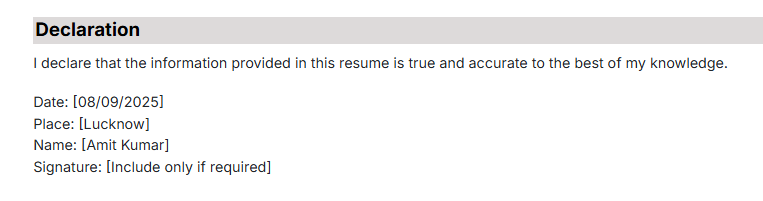
If you need to include a declaration in your resume, you can use the following format given below:
Resume Declaration Examples for Freshers and Experienced Professionals
If you are in doubt about how to write a statement in a declaration, use any of of the below example that suits your resume. The wording can remain almost the same for freshers and experienced professionals. You only need to adjust it to suit your application.
1. Resume Declaration for Freshers
Freshers may need to include a declaration when they are applying for jobs through college placement drives or formal application processes.
Example 1: Simple Declaration
| “I declare that all the information provided in this resume is true and correct to the best of my knowledge.” |
Example 2: Formal Declaration
| “I hereby declare that the details mentioned in this resume are accurate to the best of my knowledge and belief.” |
Example 3: Declaration for Campus Placements
| “I confirm that the information provided in this resume, including my education, skills, and project details, is accurate to the best of my knowledge.” |
2. Resume Declaration for Experienced Professionals
Experienced professionals can use a declaration when they are applying for jobs that require a formal statement about their qualifications and work experience.
Example 1: General Declaration
| “I declare that the information provided in this resume about my qualifications, skills, and professional experience is true and accurate to the best of my knowledge.” |
Example 2: Short Professional Declaration
| “I confirm that all the information provided in this resume is accurate and complete to the best of my knowledge.” |
Example 3: Formal Declaration
| “I hereby affirm that the details mentioned in this resume accurately reflect my qualifications and professional experience to the best of my knowledge.” |
Choose a statement that fits the application requirements. More importantly, make sure your resume accurately represents your experience, skills, and achievements so you can confidently explain them during an interview.
3. Short Resume Declaration
If the employer asks for a brief declaration, you can use a simple one-sentence statement.
Example:
| “I confirm that all the information provided in this resume is true and accurate to the best of my knowledge.” |
This declaration is suitable when a short statement is sufficient and the employer does not require any additional details.
4. Resume Declaration With Date, Place, and Signature
Some formal application formats require a declaration along with your date, place, name, and signature. You can arrange these details as follows:
| DECLARATION I hereby declare that the information provided above is true and correct to the best of my knowledge and belief. Date: 12 October 2026 Place: Pune Name: Mohit Singh Signature: As required by the application |
Replace the sample details with your own information. Use the date on which you sign or submit the declaration, as required by the application. Include your place and signature only when requested.
5. Resume Declaration for IT Professionals
IT professionals can use a declaration when the employer or application format requires confirmation of their technical qualifications and work experience.
Example:
| “I confirm that the information provided in this resume about my technical skills, certifications, projects, and professional experience is accurate to the best of my knowledge.” |
For most private-sector IT jobs, a separate resume declaration is not necessary unless the employer specifically asks for one. Focus on presenting your technical skills, projects, and work experience accurately.
6. Resume Declaration for Finance Professionals
Finance professionals can use a declaration to confirm the accuracy of their educational qualifications, professional certifications, and work experience.
Example:
| “I declare that the information provided in this resume about my education, professional qualifications, and work experience is true and accurate to the best of my knowledge.” |
Common Mistakes to Avoid in a Resume Declaration
A resume declaration is a short section, but it is still important to write it correctly when required. Here are some common mistakes to avoid.
1. Including a Declaration in Every Resume – Not every resume needs a declaration. Many private-sector employers do not require declaration. So you can check the job description, application instructions, or required resume format before adding a declaration.
2. Adding Unnecessary Personal Details – You do not need to include personal information such as your full residential address, date of birth, or family details in your declaration unless specifically requested. You can include only the information required by the employer or in application format.
3. Ignoring the Required Format – Some government job applications and college placement processes require a specific declaration format. So using a different format may cause you to miss important requirements. You can follow the given instructions and include details such as the date, place, name, or signature if required.
4. Treating the Declaration as Proof of Your Qualifications – A declaration confirms that the information in your resume is accurate. However, it does not prove that you have the qualifications, skills, or experience you have listed. So you can provide accurate information and ensure that you can explain your education, certifications, skills, projects, and work experience when asked.
5. Giving the Declaration Too Much Space – A declaration should not take up too much space on your resume. A long declaration can leave less room for important information about your skills, experience, and achievements. So you can keep the declaration brief and maintain a clean, professional layout. If it is not required, use the available space to highlight more relevant information.
6. Adding an Unnecessary Signature to a Digital Resume – A digital resume does not always need a handwritten or scanned signature. Adding one when it is not required may be unnecessary. Instead you can include a signature only if the employer or application instructions require it. Otherwise, you can use a simple declaration or leave the section out entirely if it is not needed.
FAQs
1. Is a Declaration Mandatory on a Resume?
No. A declaration is not mandatory for every resume. Include one when the employer, government application, or college placement format specifically requires it. For many private-sector jobs, you can leave it out.
2. Where Should You Put a Declaration on a Resume?
If you include a declaration, place it at the end of the resume, after your main sections, such as education, work experience, projects, and skills. Follow the employer’s format if one is provided.
3. Should Freshers Include a Declaration on Their Resume?
Freshers should include a declaration if their college placement cell or target employer requires it. Otherwise, they can use the space to highlight academic projects, internships, technical skills, and achievements.
4. Should Experienced Professionals Include a Declaration?
Experienced professionals generally do not need a declaration for standard private-sector applications unless it is requested. Their resume should focus on professional achievements, relevant skills, experience, and measurable results.
5. Can I Use the Same Declaration for Every Job Application?
You can use the same basic statement when a declaration is required, provided it accurately reflects your information and meets the employer’s instructions. However, you should not add it automatically to every resume.
6. Do I Need to Include a Signature in My Resume Declaration?
Not always. A signature may be required for a printed resume or a formal application. For a standard digital resume, include one only when the employer or application format asks for it.
7. Does a Resume Declaration Improve ATS Compatibility?
A declaration does not automatically improve your ATS score or increase your chances of shortlisting. ATS compatibility depends on factors such as readable formatting, relevant skills, job-related keywords, and clear resume structure.
Author – Ayush Panthri
Connect on LinkedIn

Reviewer – Kunal Saxena
Kunal is a seasoned Technical Resume Writer with over 13 years of experience working with startups, mid-sized firms, and top global companies like Goldman Sachs and EY. He brings deep domain expertise across tech, education, insurance, e-commerce, and investment banking.
He has helped hundreds of professionals from top firms—including Apple, Meta, Google, Adobe, and Amazon — land interviews and advance their careers globally. His approach blends real-world hiring insight with high-impact resume strategy.
Kunal is an active member of Career Thought Leaders and the Resume Writing Academy, staying current with global resume trends and recruiter expectations.
Connect on LinkedIn
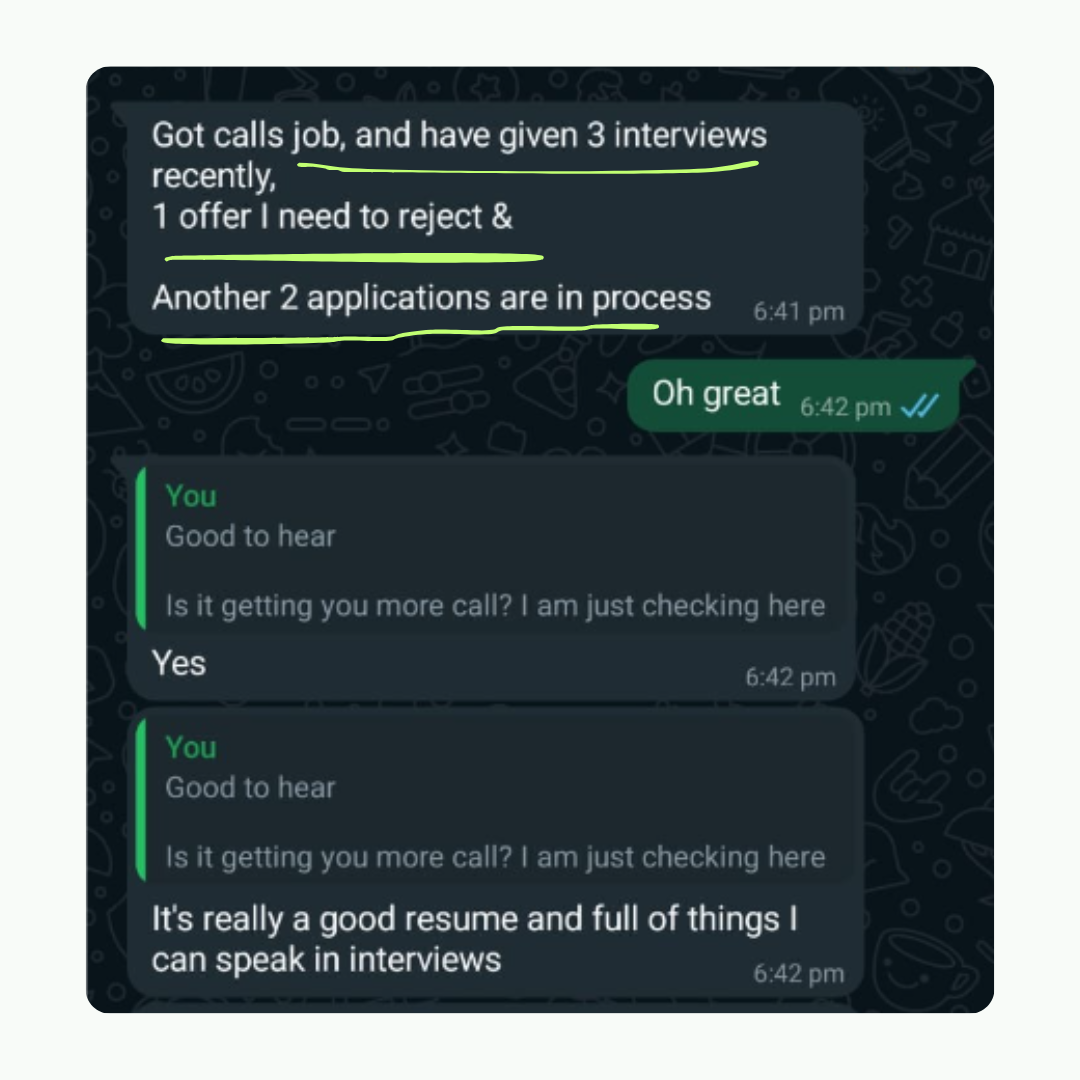
Amit got 2 Offers with our resume builder

My experience was truly outstanding, I got 3-5 interview calls and 2 job offers. The resume wasn't just focused on my current job - it captured my consulting, technical and leadership skills as well. Plus this was much more affordable
Data Engineer - Deloitte